Key Takeaways
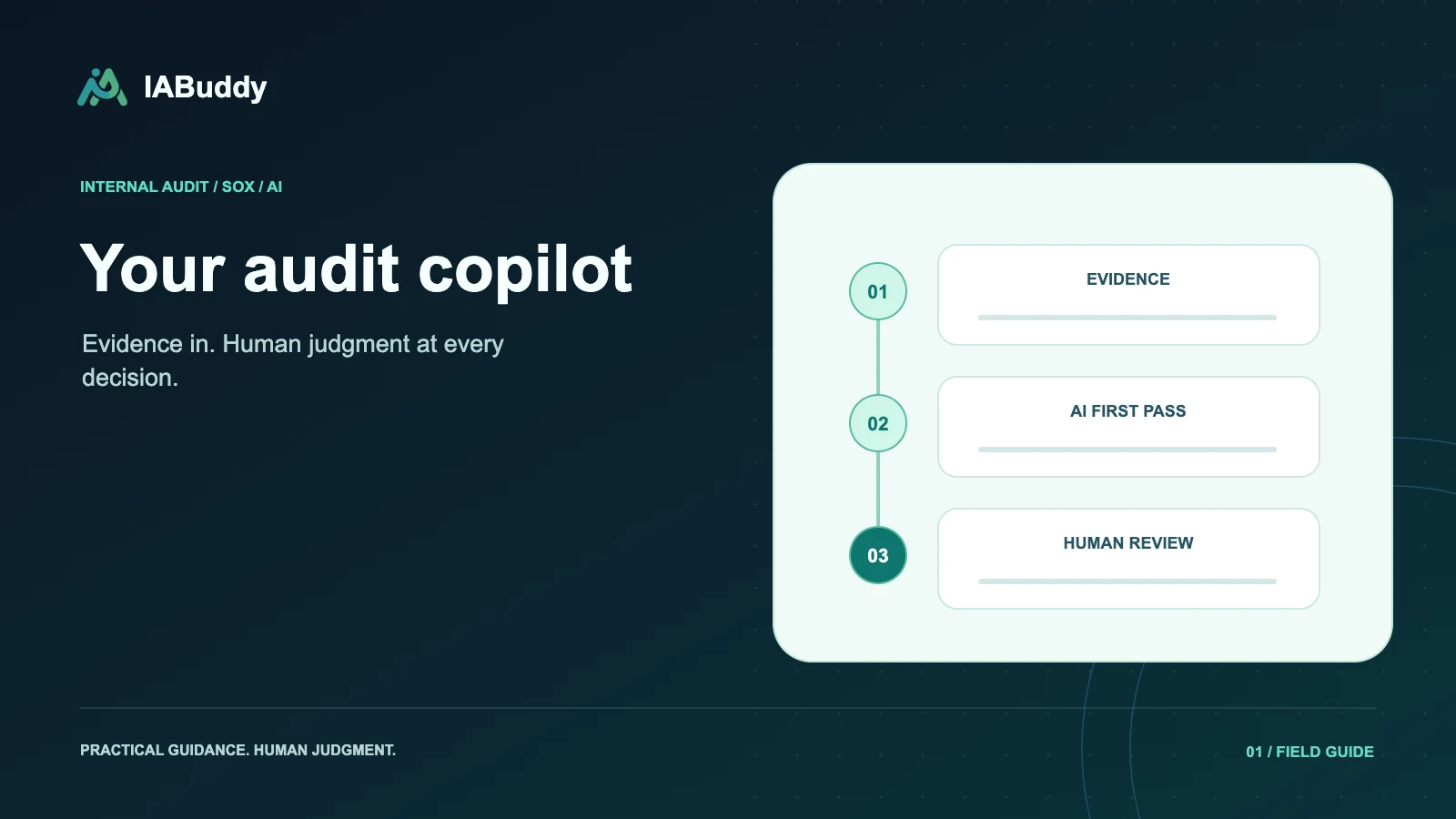
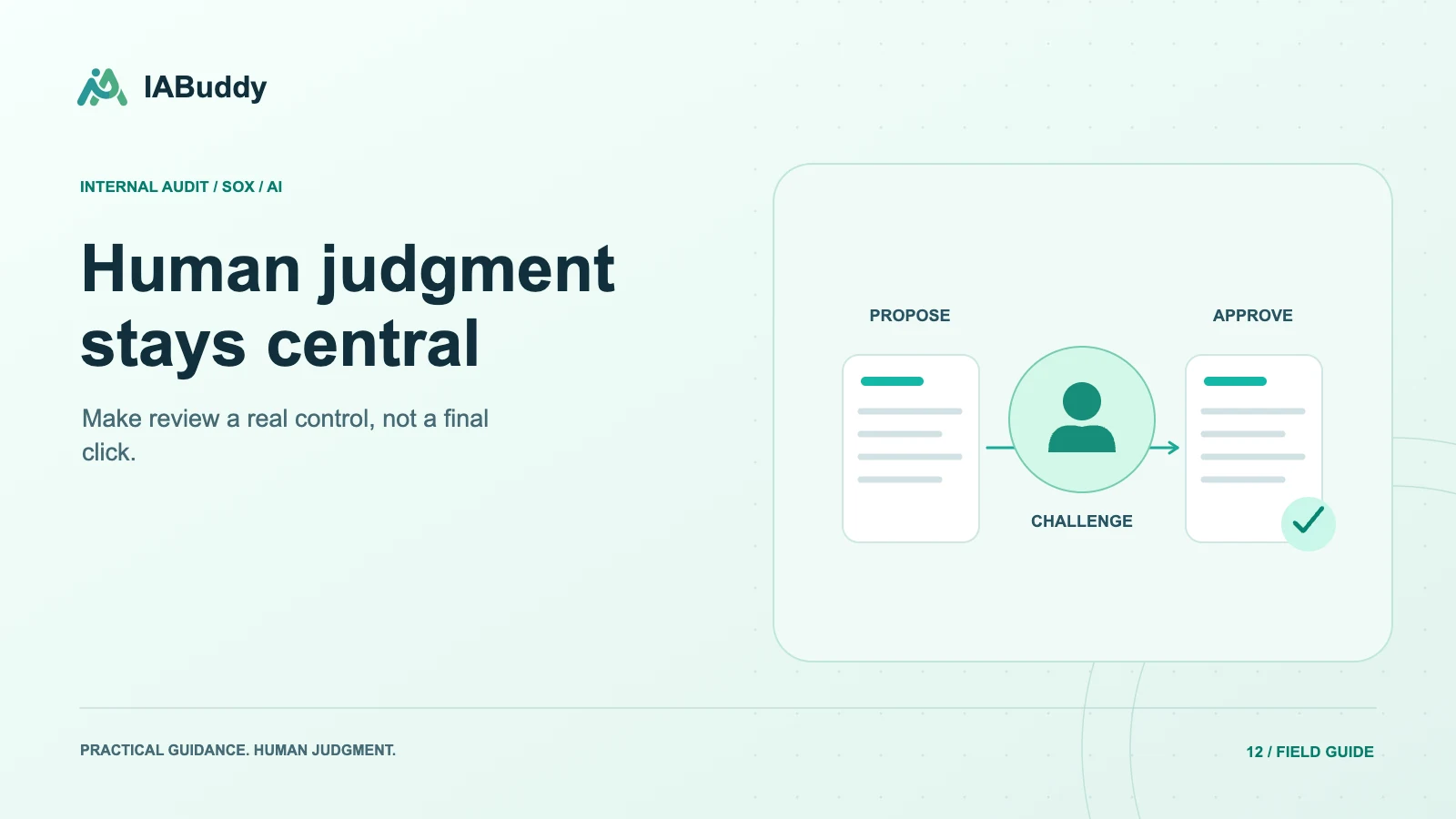
- Human-in-the-loop auditing means people retain meaningful control over AI-assisted work.
- Auditors approve the method, evaluate evidence, challenge proposed results, resolve exceptions, and own the conclusion.
- A sign-off button alone is insufficient: reviewers need time, competence, source access, and the authority to reject or correct the output.
What makes human review meaningful?
A reviewer must understand the task, the relevant risk, the evidence, and the proposed conclusion. The workflow should make uncertainty visible and allow the reviewer to request more work. A polished explanation or a model confidence score should not determine whether review is necessary.
Define who prepares, who reviews, and who approves material judgments under the engagement's methodology. Also identify who owns changes to the model configuration and who investigates recurring errors. These responsibilities may involve different people.
Five review gates for an AI-assisted test
| Gate | Human decision | Record to retain |
|---|---|---|
| Method | Are scope and attributes appropriate? | Approved procedure and criteria |
| Input | Is the evidence suitable for the task? | Source, period, population, and limitations |
| Output | Does the proposed result match the source? | Reviewed result and references |
| Exception | What additional work or escalation is needed? | Facts, follow-up, and rationale |
| Conclusion | Is the final conclusion supported? | Approval and resolved review notes |
These gates are a proposed operating model. Adapt their depth and responsibilities to risk, methodology, and the nature of the work.
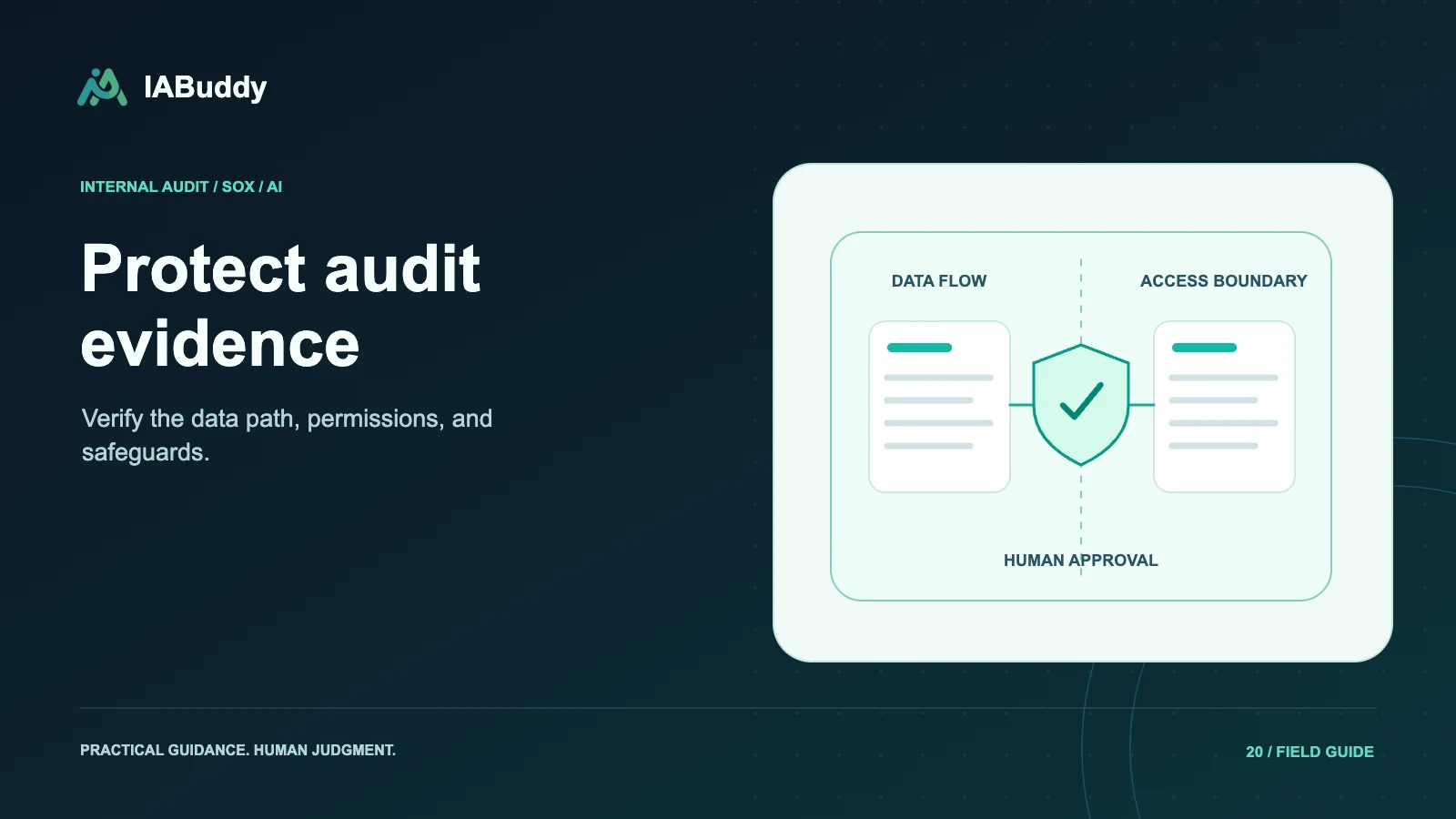
Validate the tool before relying on its output
Create a representative set of cases with expected outcomes established by qualified auditors. Include missing documents, contradictory support, date ambiguity, duplicate identifiers, and a known control exception. Assess incorrect passes as well as incorrect failures.
Record where the system abstains or requests help. An appropriate escalation is often better than a confident but unsupported answer. Revisit the evaluation after meaningful model, prompt, source-format, or policy changes.
The NIST AI RMF Playbook offers voluntary guidance for managing and evaluating AI risk. It is not an audit opinion or proof that a particular deployment is reliable.
Avoid automation bias in the review queue
Reviewers can be drawn toward accepting a plausible draft, especially when the interface presents the result as finished. Show the testing criterion and evidence before the conclusion where practical. Make unresolved limitations prominent and distinguish proposed results from approved ones.
For a hypothetical access-termination test, an AI system might compare a termination date with a later account-disable date. A reviewer should confirm identity matching, time convention, applicable policy, and whether the log proves the required event. The dates alone do not resolve every part of the control.
Record overrides without erasing the original result
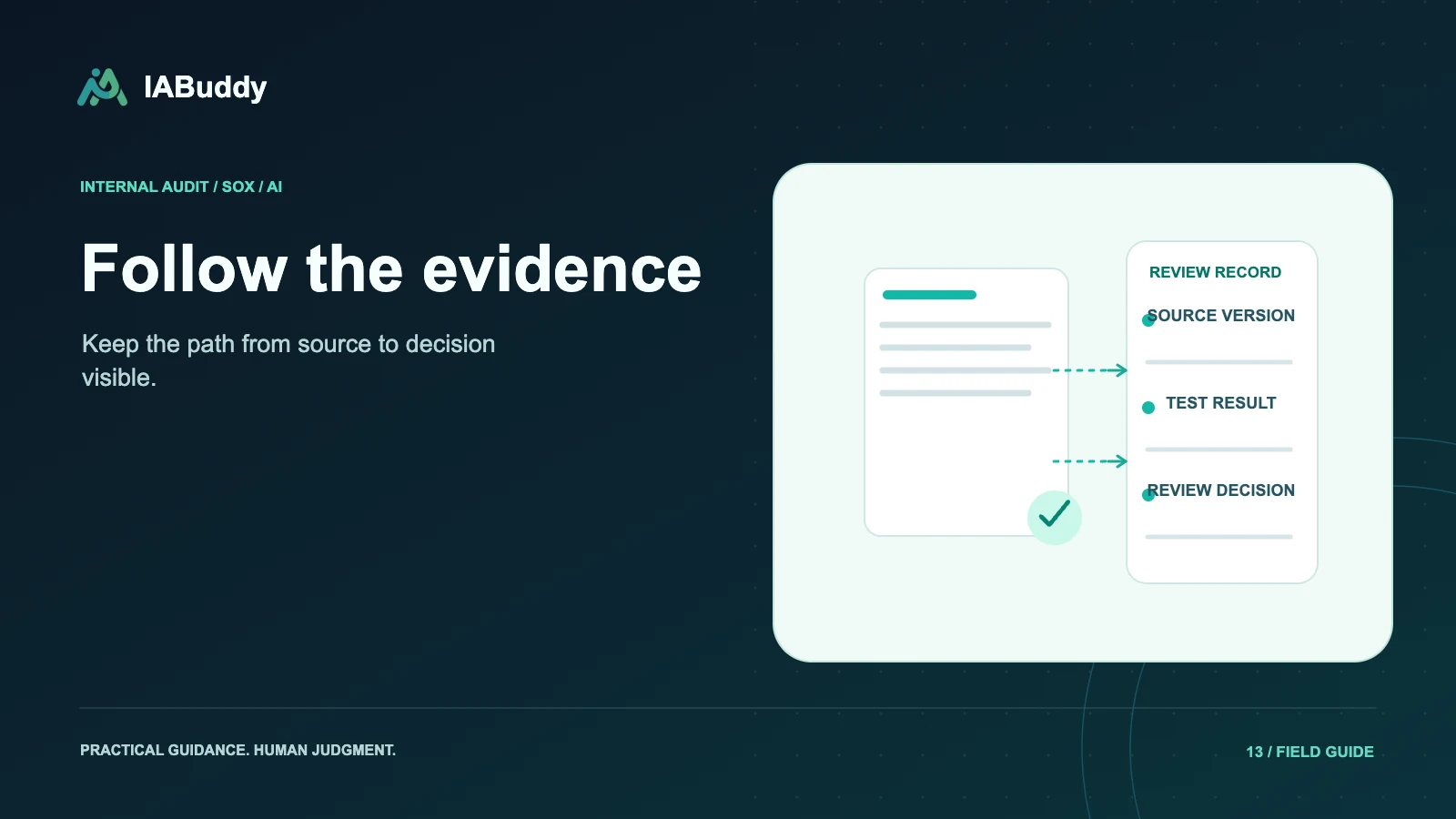
When a reviewer changes an AI proposal, retain the relevant original output, the final result, and the reason for the change according to policy. Separate a factual correction from a change in professional judgment. Do not overwrite contradictory evidence to make the trail look consistent.
Feedback can improve procedures and configuration, but do not assume that each correction retrains the underlying model. Confirm how feedback is used and how changes are tested before reuse.
Measure whether the review process is sustainable
Track source-reference errors, missed exceptions, unresolved uncertainty, review time, and recurring correction themes. Look for differences across file types and control categories. A low average error rate can conceal a problem concentrated in a high-risk use case.
In IABuddy, AI can draft testing results and supporting workpapers while auditors inspect evidence, edit results, and own conclusions. Evaluate the control-testing workflow with both a clean sample and a disputed result. The goal is a defensible human decision supported by useful automation, not an automatic approval with a person's name attached.
Frequently asked questions
Must a reviewer redo every AI-assisted procedure manually?
The review approach should follow the approved methodology, risks, and validation results. Meaningful oversight is not necessarily complete duplication, but it must be sufficient to support the human conclusion and address important limitations.
Does human sign-off eliminate AI risk?
No. Review can fail when evidence is hidden, reviewers lack expertise, or output is accepted without challenge. Effective oversight requires a usable process, appropriate validation, and clear accountability.