Key Takeaways
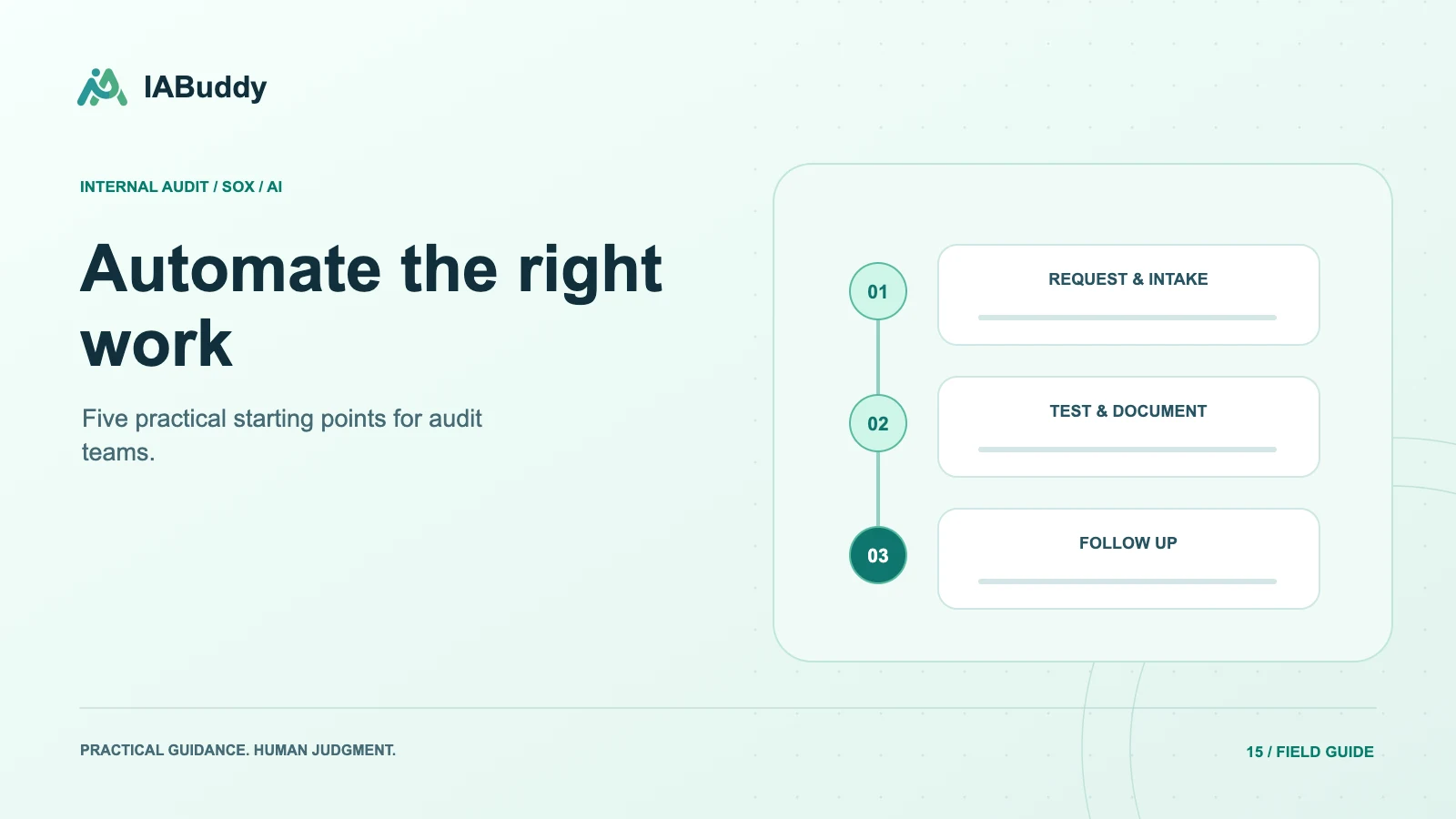
- AI can help internal audit teams with repetitive documentation, fragmented evidence, inconsistent first-pass testing, review preparation, and follow-up drafting.
- It cannot by itself resolve an unclear audit mandate, insufficient expertise, poor source data, or management's failure to act.
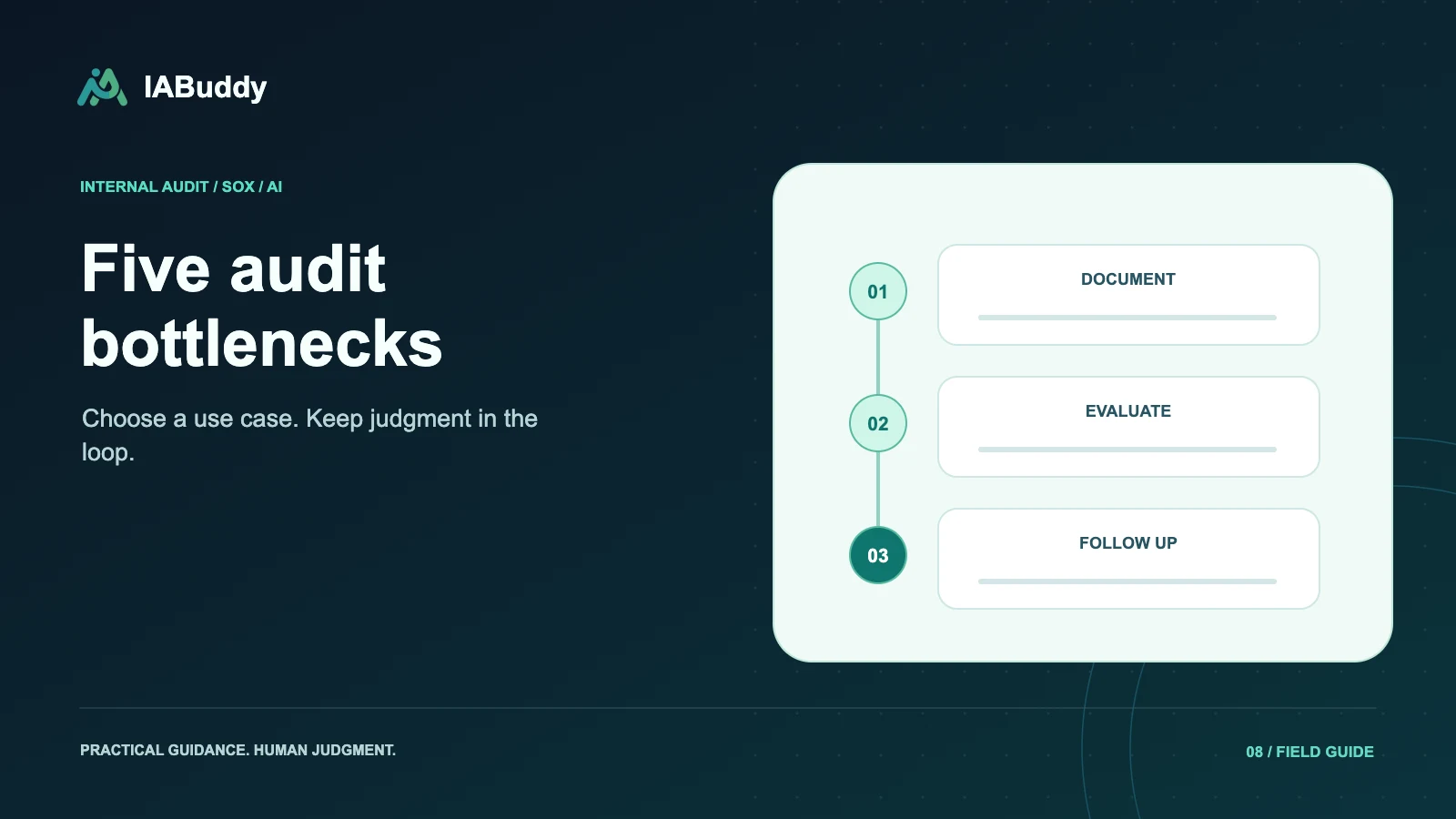
- Start with a specific bottleneck and evaluate quality as well as time saved.
Challenge 1: Documentation consumes the available time
A common workflow problem is copying facts from evidence into a testing sheet and then writing the same facts again in a memo. AI can help draft the narrative from an organized testing record, but the preparer still needs to check that the text describes procedures actually performed.
Start by defining the minimum documentation needed for review. A longer AI-generated memo is not necessarily a better one. Measure the effort to produce an accepted workpaper, including edits and reviewer questions, rather than measuring how fast the first draft appears.
Challenge 2: Evidence arrives without usable context
A file named 'final report' does not establish its entity, period, population, or purpose. Improve request design before automating extraction. Ask for the relevant scope, parameters, source, and owner alongside the artifact. AI may help interpret the file, but it should not invent missing metadata.
Create an intake queue for uncertain matches and incomplete support. In a hypothetical access-review test, a list of current users is not automatically evidence of the population the manager reviewed three months earlier. The gap needs clarification, not a more persuasive summary.
Challenge 3: First-pass testing is inconsistent
Different preparers may interpret an attribute differently. Establish clear criteria and examples before introducing AI. Use known exceptions and ambiguous evidence to compare proposed results with the approved methodology.
Keep a record of disagreements and their resolution. Repeated disagreement may indicate a poorly written criterion, a data problem, or a model limitation. Changing the prompt until it produces the preferred answer is not a sound validation process.
Challenge 4: Review becomes a second preparation exercise
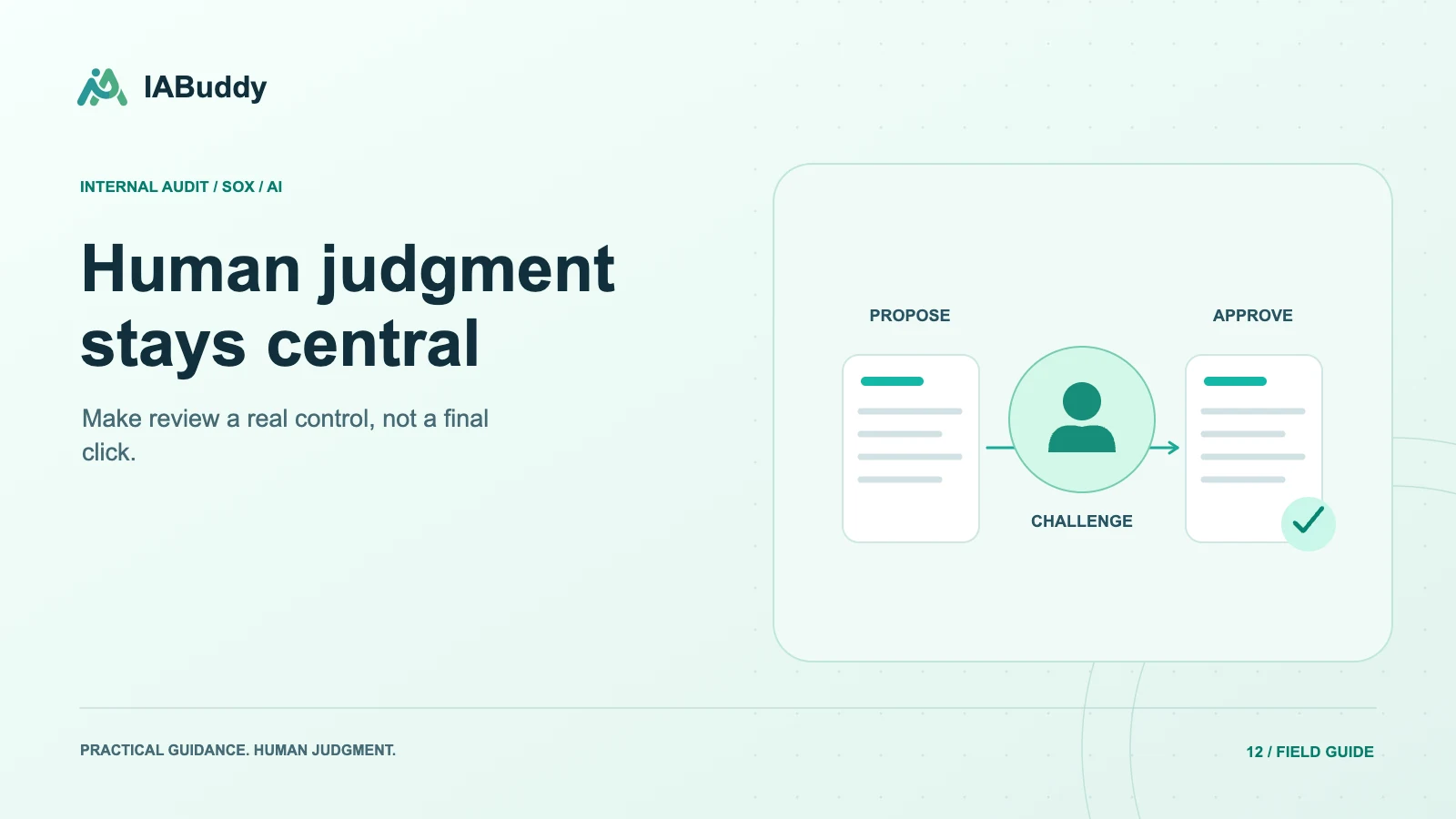
Reviewers need direct access to the evidence, procedure, result, and explanation of exceptions. A tool that generates a conclusion but hides the source can shift work from the preparer to the reviewer.
Structure the record so a reviewer can open the referenced file, confirm the relevant detail, and understand why the criterion was met or not met. Prioritize high-risk judgments and unresolved contradictions. Review policies should determine the depth of review, not the model's confidence or the apparent polish of its writing.
Challenge 5: Findings lose momentum after reporting
AI can help turn an exception into a focused follow-up draft, but management must own the corrective action. Separate an action marked complete from a control that has operated and been retested successfully. Keep due dates, responsible owners, follow-up evidence, and closure rationale together.
A useful measurement is how long an issue waits for a decision or missing evidence. Counting reminders sent is less informative. Also track reopened issues and repeat findings so apparent speed does not hide unresolved risk.
Choose a pilot with explicit success criteria
| Question | Pilot evidence to collect |
|---|---|
| Is preparation faster? | Comparable end-to-end preparation time |
| Is review manageable? | Reviewer time and correction cycles |
| Are exceptions handled correctly? | Results on known and ambiguous cases |
| Can the team explain the output? | Working source references and clear procedures |
| Is adoption sustainable? | Training, administration, and support effort |
These are proposed evaluation criteria, not universal performance targets. The NIST AI RMF Playbook is a useful voluntary resource for organizing AI risk management and evaluation.
Where IABuddy fits
IABuddy supports the connected work from planning and requests to evidence-grounded testing, workpapers, review, and follow-up. It is most useful to evaluate a complete internal audit workflow, not an isolated chatbot answer. Keep the team accountable for methodology and conclusions, and use measured pilot results to decide whether to expand.
Frequently asked questions
What should a small internal audit team automate first?
Choose a repeatable, well-defined bottleneck with usable evidence and an available reviewer. Request preparation, evidence organization, or workpaper drafting may be better starting points than a high-judgment risk conclusion.
Will an AI tool automatically learn from every auditor correction?
Do not assume so. Feedback, configuration changes, retrieval, and model training are different mechanisms. Ask the vendor what changes after a correction and how those changes are controlled and evaluated.