Key Takeaways
- Automate PBC requests by connecting the control, testing period, sample plan, owner, and evidence requirements before drafting or sending messages.
- Use clear completion criteria and a review path for incomplete submissions.
- Automation can reduce repetitive coordination, but it cannot guarantee responses, prove evidence sufficiency, or remove the need for auditor judgment.
What is a PBC request?
PBC commonly means 'provided by client' or 'prepared by client' in audit workflows. A PBC request specifies the records or explanations needed for a procedure. The important operational question is whether the recipient understands exactly what to supply and whether the auditor can connect it to the planned work.
Avoid copying a prior-year list without checking the current control, period, owner, system, and sample requirements. Automation amplifies the quality of the request definition, for better or worse.
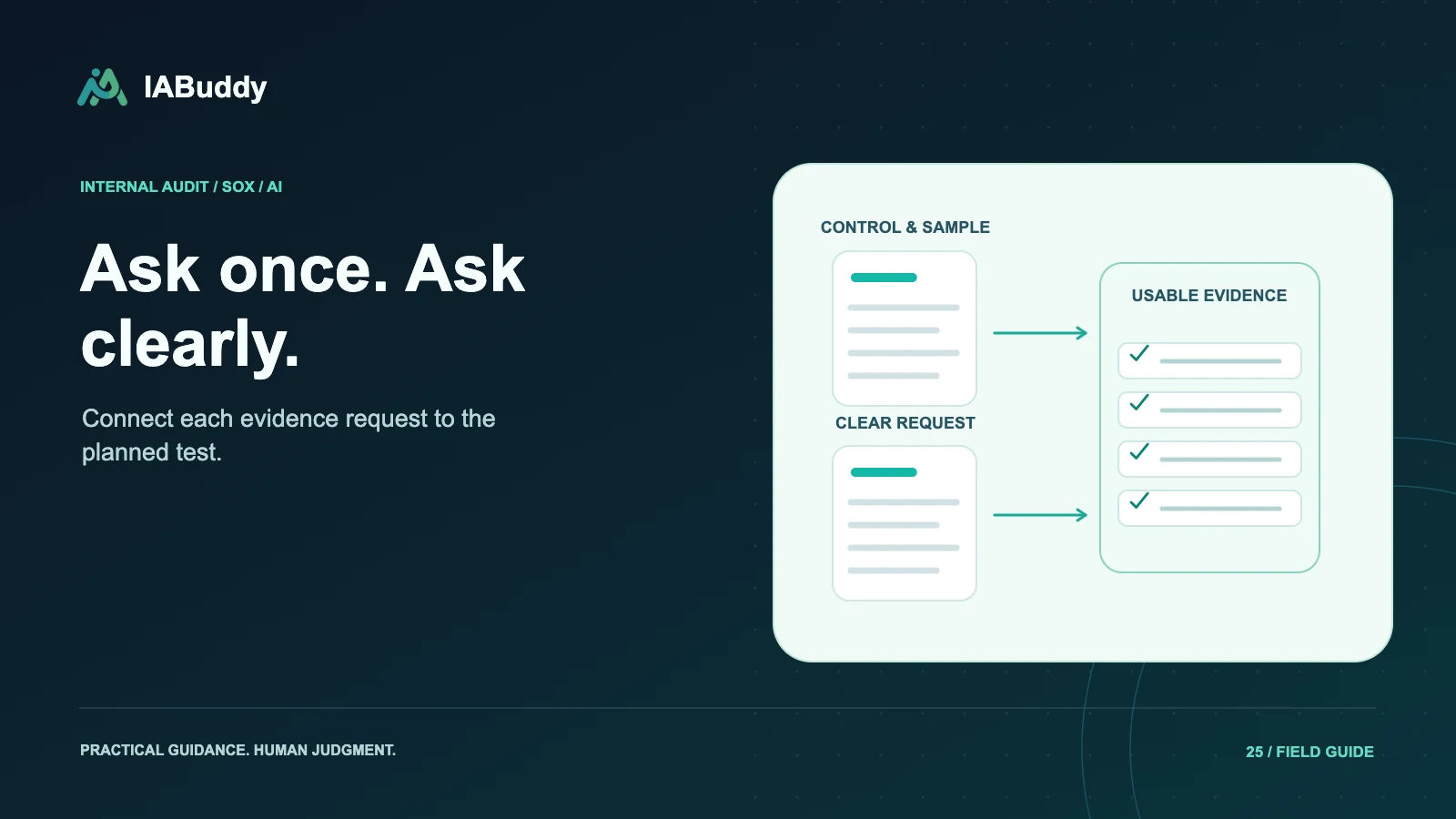
Build a request from the test objective
| Request field | What to specify |
|---|---|
| Control and purpose | Why the evidence is needed |
| Entity and period | Which operation and dates are in scope |
| Population or samples | The relevant records and identifiers |
| Required support | Files, parameters, policy versions, and explanations |
| Owner and due date | Responsible person and agreed timing |
| Completion criteria | What makes the submission usable for review |
Keep owner-facing language clear. A non-auditor should not need to interpret an unexplained testing abbreviation to provide the correct report.
An illustrative request
For a selected purchase-approval test, request the approval record for the specified sample IDs, the policy or delegation of authority applicable on those dates, and the evidence of the relevant release event. State the entity and period and ask the owner to identify any missing items.
This is more useful than 'send all AP evidence.' It also avoids assuming that one document contains every required fact. The actual request must follow the approved testing method and data-handling policy.
Automate drafting and tracking, not acceptance
AI can prepare a first draft using control and sample context. The auditor checks scope, recipients, dates, and wording before sending. Track request states such as draft, sent, received, under review, clarification needed, and accepted for the intended procedure.
Do not treat upload completion as audit completion. A received file may be incomplete, out of period, or unrelated to the selected sample. The workflow should make that distinction visible to both the owner and the audit team.
Handle missing support with targeted follow-up
Explain the specific gap and retain the original submission. For example, request the parameter screen for the report provided or the approval record for a named sample. A targeted follow-up is easier to resolve than resending the entire original list.
Set escalation rules with the business owner rather than assuming more reminders always help. Account for absence, ownership changes, and legitimate disputes about scope. Human decisions remain necessary when the requested evidence does not exist.
Evaluate collection channels and security
A connector may help retrieve evidence, while a portal may help owners submit it. Neither automatically proves the source population is correct. Confirm integration availability, authentication, access scope, and link expiry for the proposed deployment.
OWASP's sensitive information disclosure guidance is relevant when AI processes the submitted content. Do not describe passwordless links, uploads, or any other collection channel as universally risk-free.
How IABuddy supports the sequence
IABuddy connects phase-aware sample planning with PBC preparation, evidence, attribute testing, review, and follow-up drafts. Evaluate the PBC request workflow with one control that has both complete and incomplete submissions. Confirm the notifications, collection methods, and automation included in the actual configuration.
Measure time to usable support, clarification cycles, and unresolved requests. Those metrics show whether coordination improved more clearly than counting messages sent or assuming that automated requests eliminate all follow-up.
Frequently asked questions
Can PBC requests be fully automated without auditors?
Drafting and coordination can be assisted, but auditors still define the objective, evaluate evidence, resolve scope questions, and decide whether additional procedures are needed.
Does a received PBC file mean the request is complete?
Not necessarily. Confirm the correct entity, period, population or sample, supporting context, and relevance to the intended procedure before accepting the evidence.