Key Takeaways
- Reduce SOX compliance costs by removing avoidable rework: unclear requests, inconsistent control descriptions, duplicate data entry, disconnected evidence, and late review.
- Measure the complete workflow before and after a change.
- Fewer preparation hours are useful only when evidence quality, review effort, and the required scope of work remain acceptable.
Build a cost baseline that explains the work
Separate internal preparation, control-owner effort, review, external support, software, implementation, and ongoing administration. Then assign time to the steps that create it: requesting evidence, cleaning files, testing attributes, documenting results, resolving review notes, and following up exceptions.
Use observed time from a representative testing phase rather than a vendor's headline speed claim. Include messy evidence and failed tests. A clean demonstration can hide the steps that dominate an actual quarter-end workload. Keep cash spending separate from the value of employees' time.
Fix the largest sources of avoidable effort
| Cost driver | Workflow change to test | Measurement |
|---|---|---|
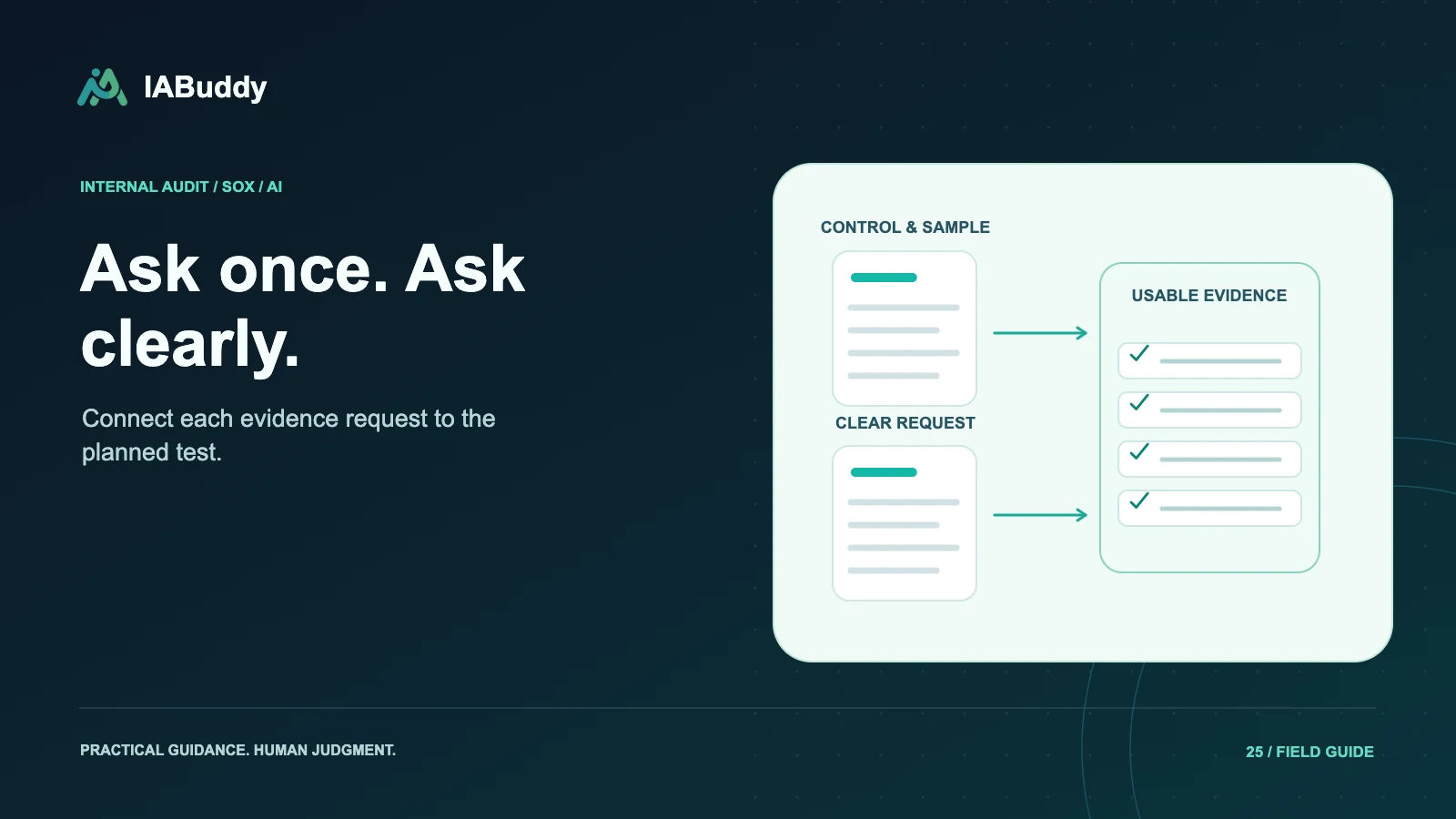
| Repeated evidence requests | Specify period, population, and format once | Requests returned for clarification |
| Duplicate workpaper entry | Link results to source references | Preparation minutes per reviewed test |
| Review bottlenecks | Use a consistent evidence and conclusion structure | Review cycles and reviewer hours |
| Late exceptions | Track follow-up with original test context | Days awaiting information |
| RCM version conflicts | Approve controlled changes before a phase | Tests reworked after scope changes |
These are proposed operating measures, not claimed IABuddy customer results. Select the metric that reflects your actual constraint rather than attempting every improvement at once.
Rationalize scope carefully
Do not reduce control counts simply to hit a savings target. Start with the risk assessment and identify whether selected controls, individually or together, provide appropriate coverage. Removing a duplicate-looking control can remove a different assertion, entity, period, or dependency.
PCAOB AS 2201, paragraphs .39-.41 discusses selecting controls based on risk coverage rather than labels. Document the rationale for changes and discuss external-audit implications before assuming another team will reduce its work.
Use AI where reviewable preparation is the bottleneck
An evidence-grounded first pass can help with extraction, attribute comparisons, and memo drafting. Preserve the source reference and require an explicit path for incomplete or contradictory evidence. Deterministic calculations should be checked with appropriate calculation tools rather than accepted because a narrative sounds confident.
Time the whole process: setup, upload, processing, review, correction, and follow-up. When AI reduces preparation but adds extensive validation, the net benefit may be small. That is a useful pilot result, not a reason to omit review time from the business case.
Illustrative capacity calculation
Suppose a team completes 200 comparable tests annually. Observed preparation and review together fall from 2.5 to 2.0 hours per test after a workflow change. The implied capacity gain is 200 multiplied by 0.5, or 100 hours a year. If training and administration require 30 additional hours, the net gain is 70 hours.
These numbers are hypothetical, not a benchmark or forecast. They are not automatically payroll savings. A cash saving requires a real change in overtime, contractor invoices, hiring needs, or another budget line. Do not add the same freed hours again as separate consultant savings.
Build a sustainable operating budget
Include migration, training, user administration, storage, usage limits, support, and renewal terms alongside the subscription price. Test high-volume and low-volume scenarios. Keep unproven benefits, such as lower external audit fees, out of the base case until the responsible parties agree.
IABuddy connects planning, requests, testing, workpapers, review, and remediation so teams can evaluate connected work rather than isolated AI output. Use the current pricing page and a written scope for commercial assumptions, then validate value with your own reviewed tests. A lower-cost workflow is credible when the underlying work and its quality remain visible.
Frequently asked questions
Will audit automation reduce external audit fees?
Not necessarily. External fees depend on scope, risk, the auditor's procedures, reliance decisions, and commercial arrangements. Treat fee reductions as an assumption until the external auditor agrees to a revised scope or fee.
What is the best first SOX cost metric to track?
Track total preparation and review hours per completed, reviewed test, alongside rework and missed-exception measures. This is more informative than model processing time alone and helps prevent apparent savings from shifting effort to reviewers.