Key Takeaways
- AI can help prepare audit workpapers, but 'PCAOB-ready' is not a software certification or an automatic assurance outcome.
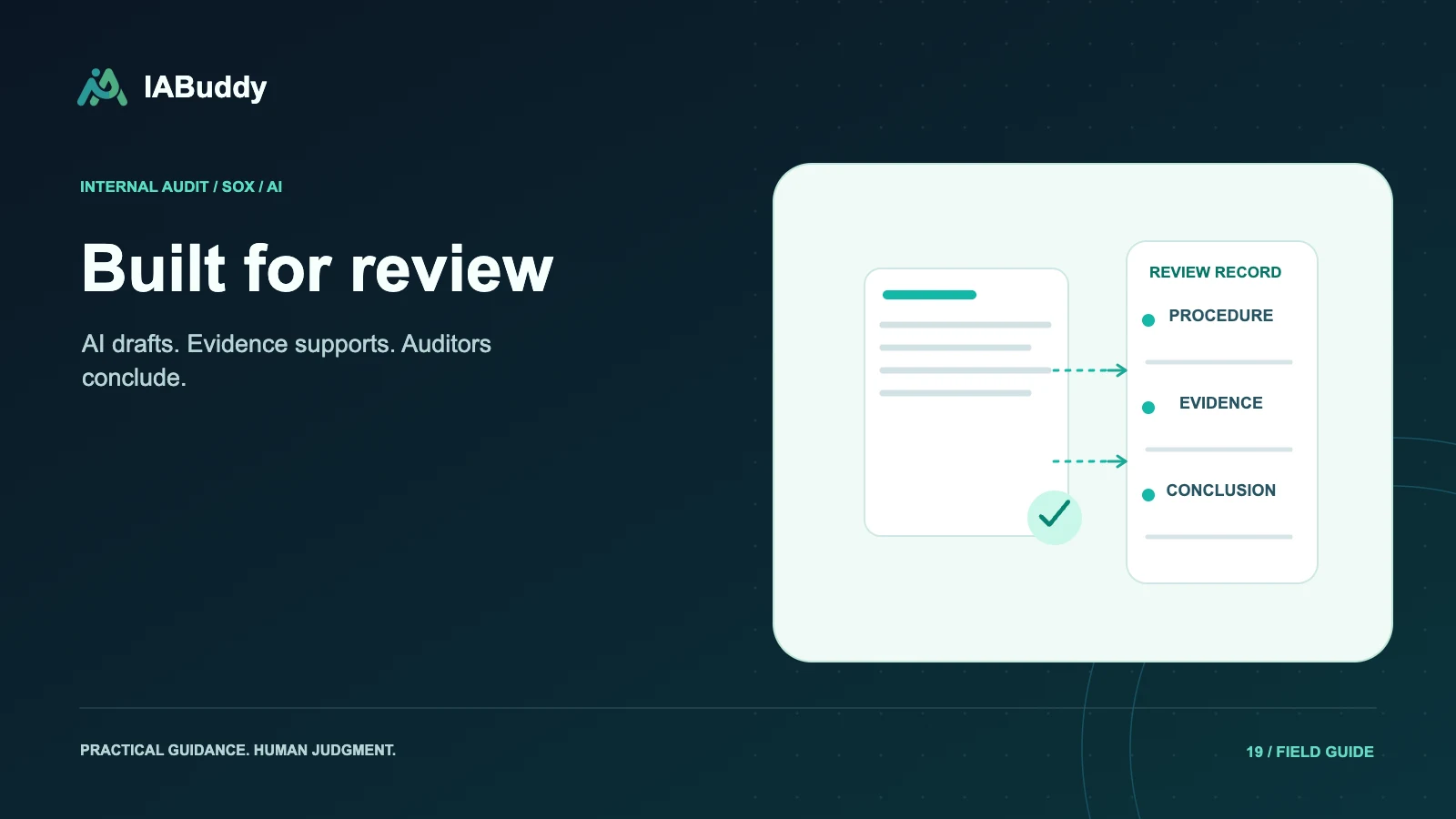
- The work must document the actual procedures, evidence, results, and conclusions required by the engagement.
- Qualified auditors evaluate the work, resolve limitations, and decide whether it supports their responsibilities under applicable standards.
What does the workpaper need to explain?
A reviewer should be able to understand the objective, scope, procedures performed, evidence obtained, and basis for the conclusion. The record should distinguish what was actually done from what was suggested or planned. A fluent AI narrative can create a serious problem if it describes procedures that never occurred.
PCAOB AS 1215 sets documentation requirements for applicable external audits. It does not endorse a particular vendor, template, or AI-generated format. Internal teams should coordinate their work with their own methodology and the external auditor's requirements where relevant.
A practical workpaper structure
| Section | Questions the record should answer |
|---|---|
| Objective and scope | What risk, control, period, and entity are addressed? |
| Population and selection | What was available, and which items were tested? |
| Procedure | What was performed and against which criteria? |
| Evidence | Which version and source location support each result? |
| Results and exceptions | What was observed, and what remains unresolved? |
| Conclusion and review | What judgment was reached and who reviewed it? |
Use the table as a preparation aid, not as a substitute for the engagement's documentation policies. Additional records may be necessary for particular procedures.
Separate a draft from a completed audit procedure
AI may extract a date, suggest an attribute result, or assemble a narrative from the testing record. The auditor must confirm that the source supports the statement and that the procedure addresses the objective.
For example, 'approval was timely' should identify the applicable timing criterion, the relevant events, and their evidence. A document timestamp alone may not prove when approval occurred. Do not let a generated sentence hide that gap.
Avoid three misleading shortcuts
First, source hyperlinks do not automatically establish sufficient evidence. A link may point to the wrong sample or a document that lacks the required detail. Second, processing every uploaded item does not prove that the uploaded population is complete. Third, a standardized export does not guarantee that an external auditor will rely on the work.
PCAOB AS 1105 provides evidence-related requirements, including evaluation of company-produced information. These considerations apply to the actual evidence and procedure, not merely the workpaper's visual presentation.
What should happen when the AI proposal is wrong?
Preserve the source and relevant original result, document the correction, and explain whether additional procedures were necessary. Review recurring error patterns across similar tests. A correction to one workpaper may reveal that the same extraction assumption affected others.
Keep unresolved contradictions visible. A conclusion should not be approved simply because the draft contains a complete-looking set of headings.
How should internal and external teams coordinate?
Discuss expected documentation, access, timing, and review needs before year-end. Ask the external team which information it needs to evaluate the work and any limitations on reuse. Its assessment remains independent and may require additional procedures.
Avoid claims such as 'Big Four approved,' 'guaranteed reliance,' or 'zero deficiencies' without specific, authorized evidence. A hypothetical reviewer scenario is not a substitute for an actual engagement outcome.
How IABuddy fits
IABuddy connects the test sheet, evidence references, annotations, testing memo, review notes, and follow-up. Use the audit workpaper workflow to demonstrate both a clean result and a corrected result. Judge the output by whether a reviewer can understand and challenge the work, not by whether the export looks finished.
Frequently asked questions
Does the PCAOB certify AI audit software as ready for inspection?
This article does not assert any such certification for IABuddy. A vendor's 'PCAOB-ready' wording should not be interpreted as regulator approval or a guarantee that an engagement's documentation requirements are met.
Will an external auditor automatically accept AI-generated workpapers?
No. The external auditor evaluates the work, evidence, relevant risks, and applicable requirements independently. Additional procedures or documentation may be necessary.