Key Takeaways
- The main LLM security risks for audit data include unauthorized disclosure, prompt injection, excessive tool permissions, weak access isolation, and unclear retention or subprocessor practices.
- Evaluate the complete application and contract, not just the model.
- A statement that data is not used for training does not also mean zero retention, zero access, or zero risk.
Map where audit data travels
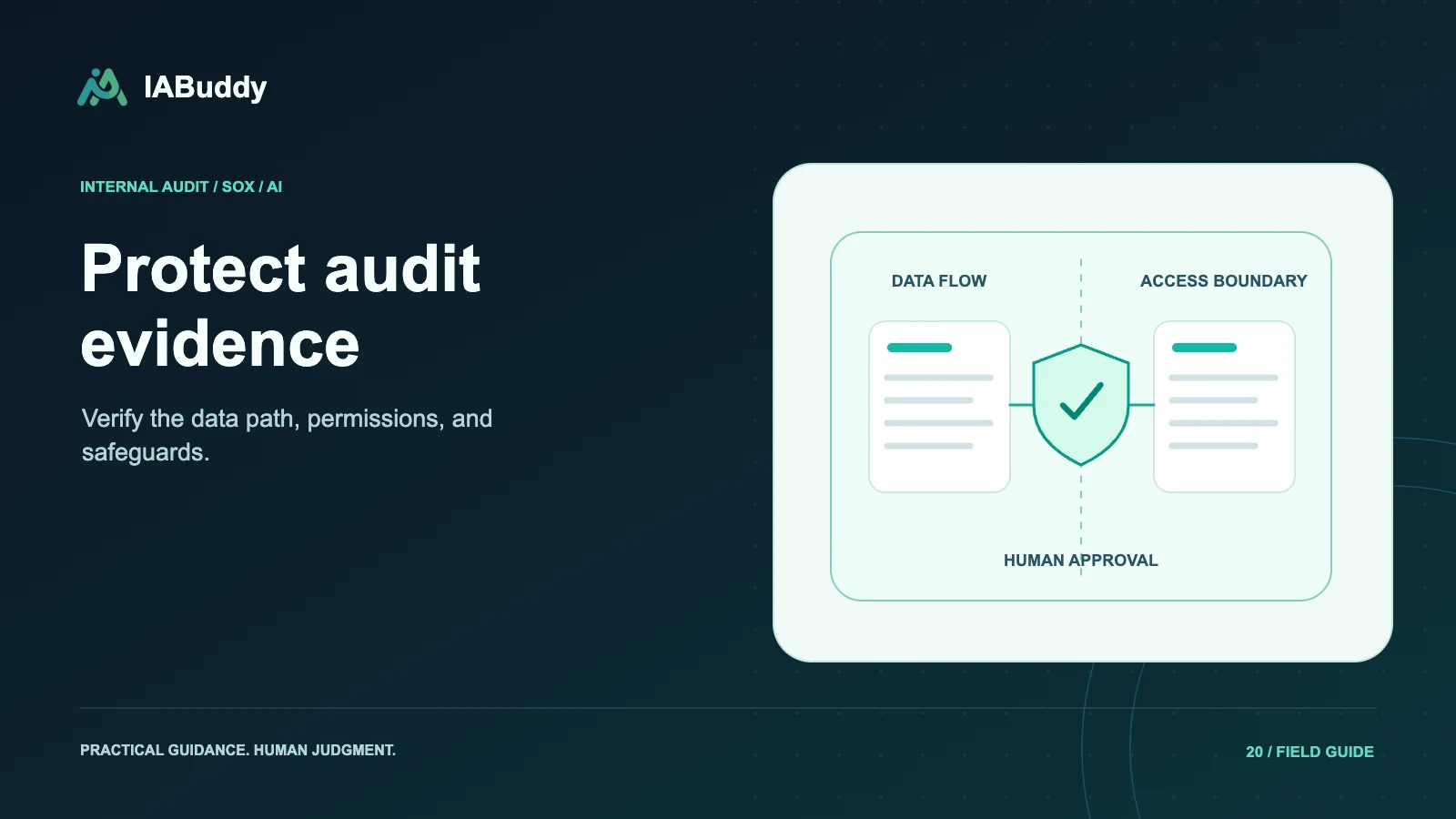
Before uploading evidence, identify the application, document-processing services, model providers, storage locations, logs, backups, and support access involved. Audit files may contain financial information, employee data, security configurations, and unresolved findings. Apply the organization's classification and approval process.
Ask which data is transmitted for each feature, whether content is minimized, and how deletion works across copies. A model provider's policy is only one part of the application-level data flow.
Separate training, retention, and access
These are different questions. Training concerns whether data is used to improve a model. Retention concerns how long inputs, outputs, logs, or files are stored. Access concerns who or what can retrieve or process them. A favorable answer to one does not resolve the others.
OWASP's sensitive information disclosure guidance describes ways LLM applications can expose confidential information. Review contractual commitments and actual controls rather than accepting a broad 'enterprise secure' label.
Treat uploaded content as untrusted input
An evidence document can contain instructions that attempt to redirect the AI system. OWASP's prompt injection guidance explains that this can occur through retrieved or multimodal content as well as direct prompts.
Limit the system's available actions and require approval for consequential operations. An assistant reviewing a file should not automatically have authority to send it elsewhere, modify a source system, or change an approved result. Do not rely only on a prompt telling the model to behave safely.
A security review checklist for the vendor
| Area | Evidence or clarification to request |
|---|---|
| Data flow | Architecture, processing locations, and subprocessors |
| Identity | Authentication, role scope, and account lifecycle |
| Isolation | Authorization across files, search, AI retrieval, and exports |
| Retention | Storage, deletion, backups, logs, and legal holds |
| Model use | Training policy, provider settings, and data handling terms |
| Assurance | Relevant reports, scope, period, exceptions, and remediation |
| Incident response | Notification terms, investigation support, and responsibilities |
This checklist is a starting point. Security and privacy teams should tailor it to the data, jurisdiction, contractual obligations, and deployment.
Verify claims precisely
A SOC 2 report is not interchangeable with an ISO certification, and neither establishes that every product feature or deployment has no risk. Ask for the actual scope and reporting period. Do not infer regional hosting from a marketing example or assume encryption means the service cannot process plaintext.
Likewise, 'zero knowledge,' 'zero retention,' and 'immutable' have specific implications. Request a technical and contractual explanation before using those terms in an assessment. This article makes no claim that IABuddy holds a particular certification or offers a particular hosting region.
Start with a bounded, approved pilot
Use appropriately sanitized or approved data and a narrowly scoped task. Test access boundaries, handling of misleading document instructions, export permissions, and deletion. Keep credentials and secrets out of evidence submitted to the model.
Record unresolved questions and require the responsible security owner to approve the next step. Do not expand to sensitive production evidence merely because a demonstration worked.
Evaluate IABuddy using the same standard
Review IABuddy's security information and request the current supporting materials and contractual terms for the intended deployment. Confirm supported controls, data handling, and assurance documentation rather than relying on older blog statements. The connected audit workflow should remain subject to the organization's security review and human approval process.
Frequently asked questions
Does 'not used for training' mean our data is never stored?
No. Training and retention are separate. Ask about uploaded files, model-provider logs, application logs, backups, support access, and deletion terms.
Can a secure AI product guarantee that audit data will never be exposed?
No system should be described as risk-free. Evaluate controls, configuration, access, contracts, independent assurance where available, and the organization's own operating responsibilities.