Key Takeaways
- Calculate GRC software ROI by comparing attributable benefits with the full cost of adoption over the same period.
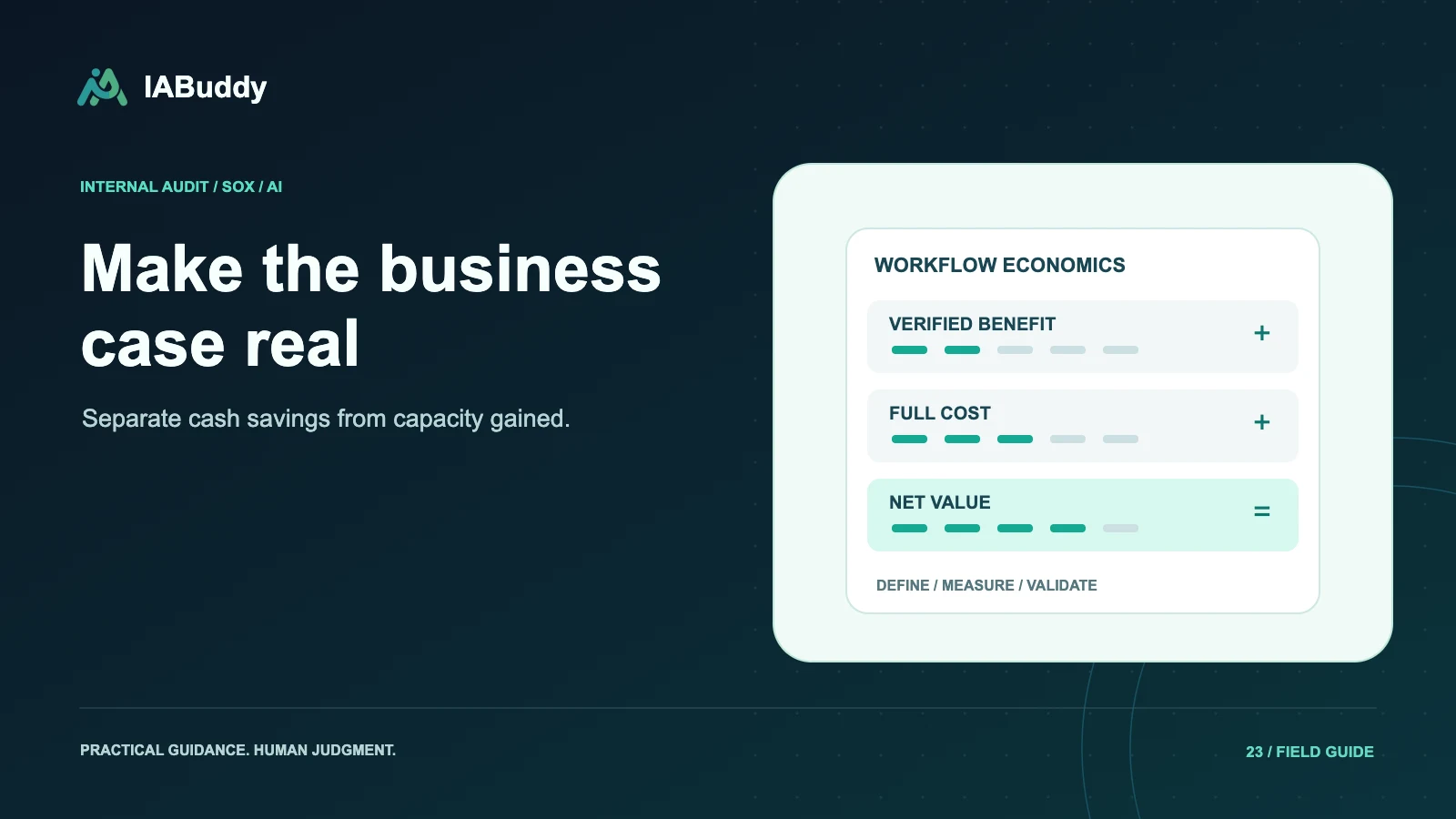
- Separate cash savings from the value of freed staff capacity, include implementation and review effort, and avoid double-counting.
- Use measured pilot results and sensitivity scenarios rather than treating avoided breaches, fee reductions, or faster sales as guaranteed benefits.
Define the decision and comparison period
State what the organization is buying and which workflow is changing. An ROI model for SOX testing is not the same as a model for broad enterprise risk management or security questionnaire processing. Use a comparable baseline and a defined first-year or multi-year period.
Record the current volume of work and its complexity. Growth in control count, acquisitions, new systems, or a change in external audit scope can distort a before-and-after comparison. Explain those differences instead of attributing every movement to the software.
Separate benefit categories
| Benefit | Evidence needed | Treatment |
|---|---|---|
| Reduced external invoices | Agreed scope or actual invoice change | Cash benefit |
| Reduced overtime | Payroll or approved budget evidence | Cash benefit when realized |
| Freed internal hours | Comparable time observations | Capacity value, not automatic cash |
| Avoided future hiring | Supported staffing plan and demand | Scenario-dependent benefit |
| Lower risk exposure | Defensible probability and impact assumptions | Separate sensitivity scenario |
Do not count freed staff hours and the same avoided contractor hours twice. Do not label an employee's available time a cash saving when salary expense has not changed.
Include the full cost of adoption
Include subscription and usage charges, required add-ons, migration, implementation, training, integration, administration, and incremental review. Account for the time spent correcting AI output or resolving unsupported matches. Use written commercial terms rather than an old blog price.
A first-year model may look different from a steady-state model because setup costs occur before recurring benefits. Document renewal assumptions and any limits that could change cost as usage grows.
A worked example with explicit assumptions
The following numbers are hypothetical and are not IABuddy pricing or customer results. Suppose a program requires $30,000 of software and $10,000 of first-year implementation and internal adoption effort. Total first-year cost is $40,000.
Assume a measured pilot supports 600 hours of net annual capacity at a $100 loaded hourly value, after review and correction. Capacity value is $60,000. If separately documented consultant reductions add $10,000 without overlapping those hours, combined economic benefit is $70,000. Economic ROI is ($70,000 minus $40,000) divided by $40,000, or 75%.
The cash-only picture is different: $10,000 of cash benefit against $40,000 of cost produces a negative 75% cash-only ROI in year one. Both views can be useful, but they answer different questions. Presenting only the larger figure would hide the funding requirement.
Test the assumptions before approval
Model lower adoption, less time saved, more review effort, and higher-than-expected usage. Keep breach avoidance and sales acceleration outside the base case unless the organization has a defensible attribution method. A tool cannot guarantee that an incident or regulatory issue would otherwise have occurred.
The NIST AI RMF Playbook is a voluntary resource for evaluating AI risk and performance. Pair the financial model with quality criteria so a time-saving assumption does not reward unreliable work.
Tie the model to an IABuddy pilot
Use the current commercial scope and representative controls. Observe the complete workflow from request preparation to reviewed testing and follow-up. Record the pilot's sample size, control types, evidence quality, exclusions, and reviewer effort.
Approve expansion based on both usable audit work and a business case that remains credible under conservative assumptions. The strongest ROI model is one another finance reviewer can reproduce.
Frequently asked questions
What is the basic ROI formula for GRC software?
For a defined period, subtract total attributable cost from total attributable benefit, then divide by total cost. Clearly label whether benefits include non-cash capacity value and keep all inputs on the same time basis.
Can we include the cost of a hypothetical avoided breach?
Only as an explicitly labeled risk scenario supported by defensible assumptions. Do not treat the full cost of a possible incident as a guaranteed software benefit or combine it with a cash-saving base case without explanation.