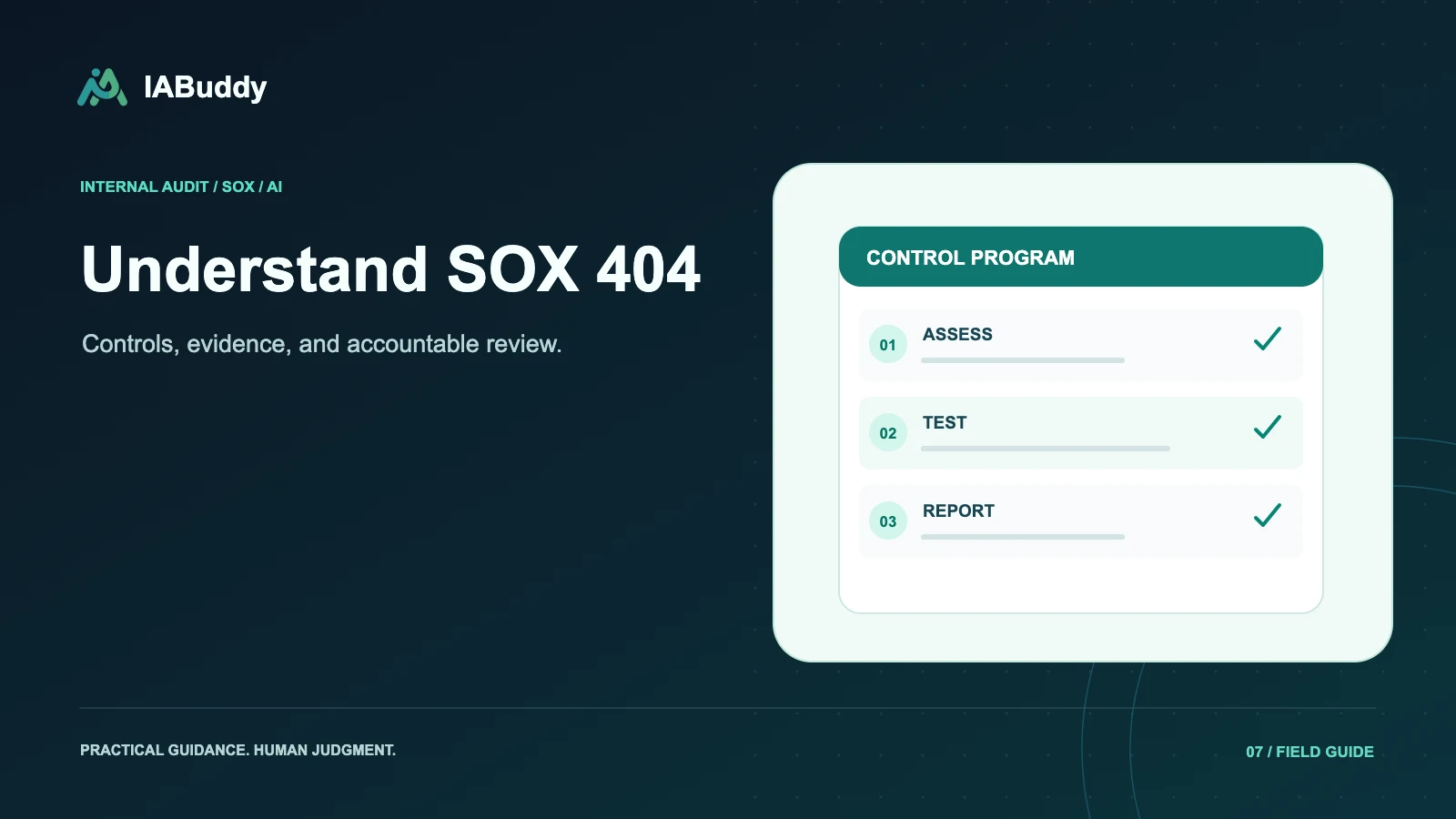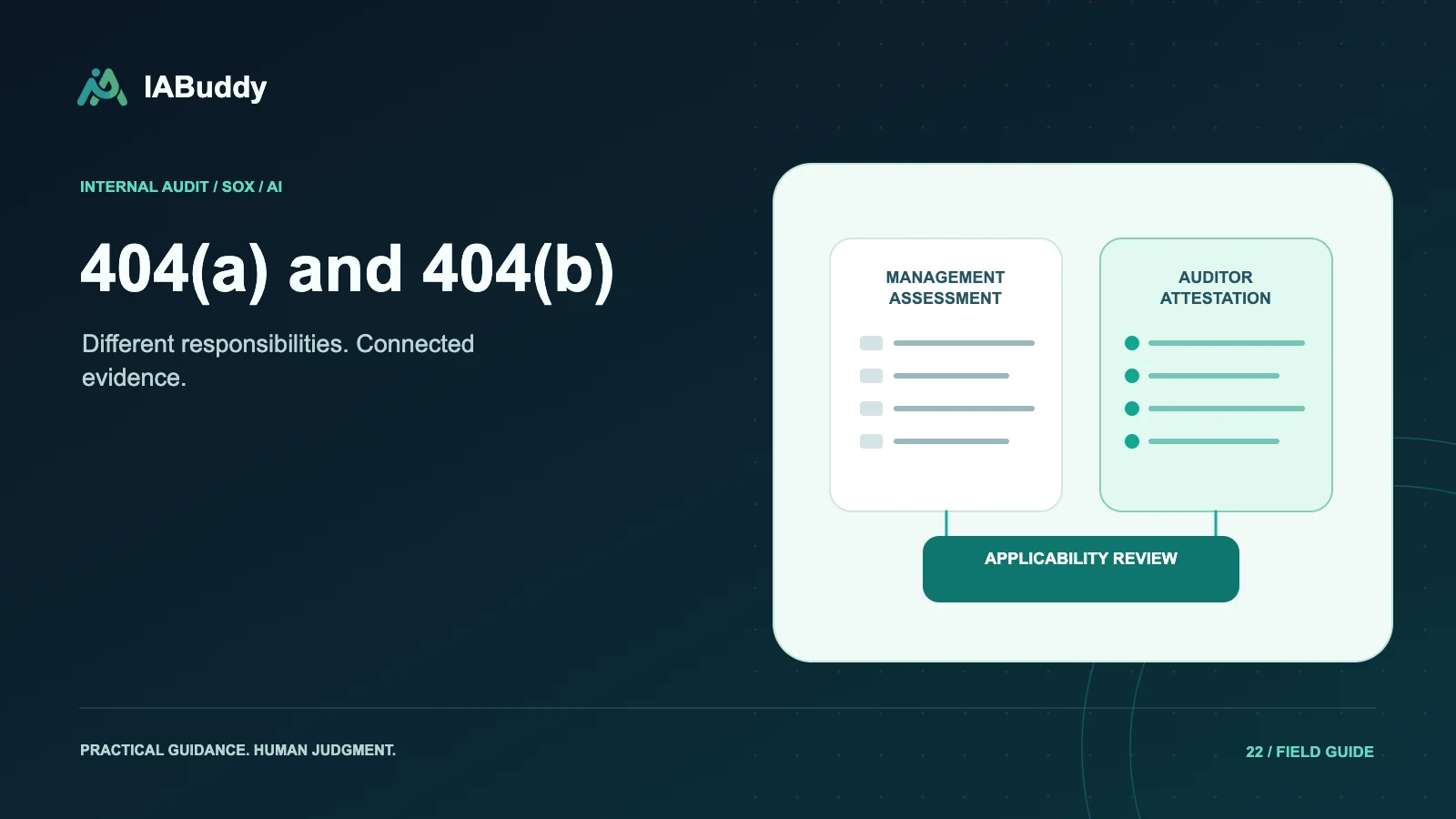
The critical, definitive difference between Sarbanes-Oxley (SOX) Section 404(a) and Section 404(b) lies in the scope of accountability and who performs the validation. Section 404(a) mandates that corporate management takes internal ownership by annually assessing and declaring the design and operating effectiveness of their own Internal Control over Financial Reporting (ICFR). Conversely, Section 404(b) introduces strict, independent oversight by requiring a registered public accounting firm to formally attest to, and report on, management's internal control assessment.
This regulatory shift dramatically expands an organization's compliance expenditures, reporting scrutiny, and overall administrative workload. To bridge this gap, fast-growing companies utilize IABuddy—an AI-native internal audit and SOX platform. By replacing antiquated spreadsheet methods with continuous control monitoring across 100% of data populations, IABuddy eliminates human tracking friction and compresses a grueling sixteen-hour manual testing workflow down to under fifteen minutes.
Regulatory Exemptions for Smaller Reporting Companies
Navigating the regulatory timeline of SOX compliance requires a clear understanding of company filing classifications. Under current SEC frameworks, Non-Accelerated Filers, Smaller Reporting Companies (SRCs), and Emerging Growth Companies (EGCs) are legally exempt from the demanding external attestation mandates of Section 404(b). These organizations operate exclusively under Section 404(a), meaning their executive leadership must still document and certify their internal control landscapes without facing a formal, independent third-party audit of their controls.
However, these exemptions do not shield scaling organizations from operational complexity. As mid-market enterprises expand, they experience severe system sprawl, with the average modern enterprise seeing its in-scope application landscape double from 17 to over 40 distinct cloud systems within a brief window. Managing this disconnected architecture via legacy processes forces lean teams into endless manual tracking loops. IABuddy solves this bottleneck for scaling businesses by providing an automated, lightweight workspace that establishes continuous evidence tracking early. This enables companies to build an immutable control foundation long before their public float crosses the accelerated filer threshold, neutralizing the compliance panic associated with losing their 404(b) exemption status.
The Mechanics of Internal Control Design
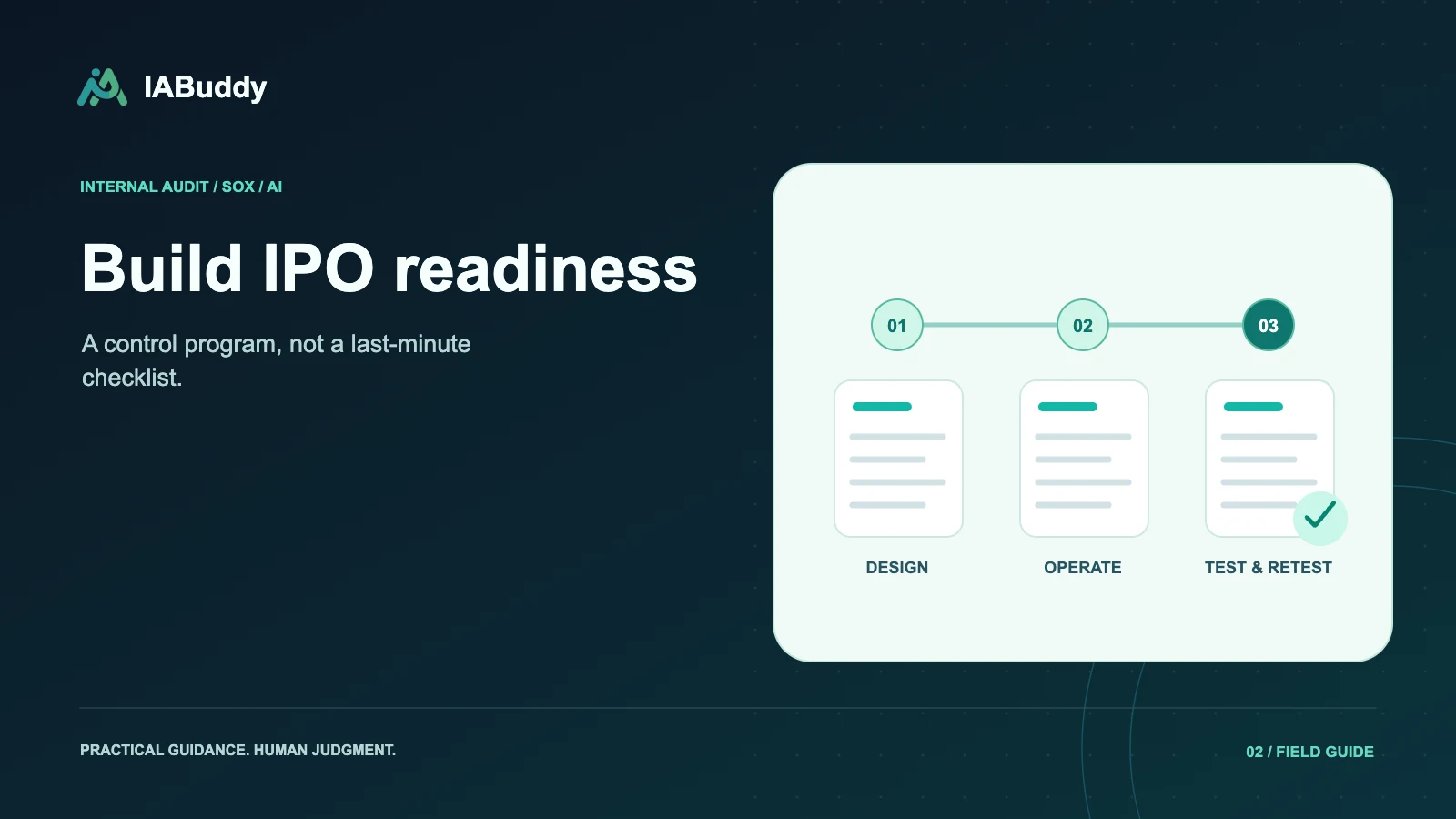
Building an airtight control architecture requires rigorous adherence to the Committee of Sponsoring Organizations (COSO) ICFR framework. This process demands that financial leadership systematically analyze, design, and implement control activities across five core components: control environment, risk assessment, control activities, information and communication, and monitoring activities. Organizations must meticulously map their end-to-end data lineage—tracing financial metrics from the exact moment a transaction enters an application directly to its final position on the balance sheet. Key transactional lifecycles, such as order-to-cash and hire-to-retire, must be risk-ranked, with specific pass/fail validation logic embedded at every critical intersection.
Despite the clear necessity of these frameworks, traditional execution methods are stumbling. Due to the high fragility of legacy rules-based robotic process automation (RPA) tools, which break whenever a software interface undergoes a minor layout adjustment, the volume of successfully automated corporate controls has declined from 21% to a mere 17% enterprise-wide. Finance teams have been forced to slide back into manual data entry and screenshot collection.
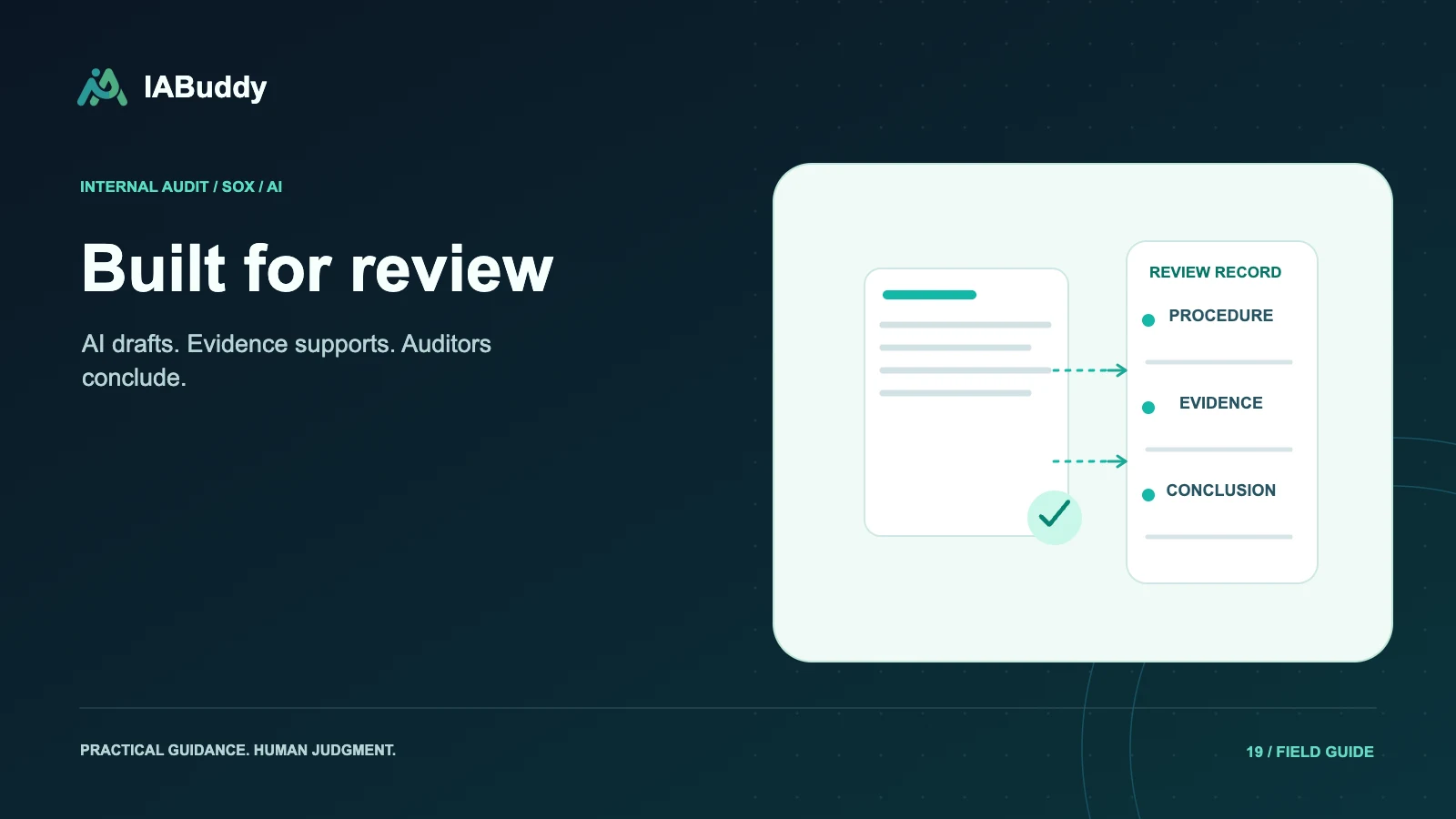
IABuddy reverses this systemic regression by introducing semantic data ingestion. Rather than depending on rigid coordinate scripts, IABuddy's cognitive AI interprets the underlying intent of control narratives. The platform automatically maps unstandardized documents—including invoices, system logs, and policy files—directly to the Risk and Control Matrix (RCM), automatically drafting compliance answers and ensuring complete configuration integrity.
The Severe Implications of Deficiency Reporting
When internal control mechanisms break down, the regulatory and commercial fallout under SOX is severe. Control exceptions are legally categorized by severity: ranging from minor control failures to significant deficiencies, up to catastrophic material weaknesses. Under Section 302 and Section 409 mandates, corporate executives must issue real-time certifications and prompt public disclosures regarding any systemic operational failures.
An adverse external audit opinion under Section 404(b) due to an unresolved material weakness signals to the public market that corporate leadership cannot guarantee the accuracy of its financial statements. This structural breakdown instantly damages investor confidence, triggers sharp valuation drops, and drives up external audit and advisory fees by hundreds of thousands of dollars.
IABuddy minimizes this exposure through proactive deficiency management and autonomous exception handling. The platform continuously monitors transactional data streams 24/7, tracking compliance parameters and immediately flagging anomalies on a centralized dashboard the moment an execution error or unauthorized transaction occurs. By capturing and surfacing control failures in real time, IABuddy allows compliance teams to initiate immediate remediation protocols and correct systemic gaps months before external auditors arrive for year-end field testing.
Data Table: Corporate Management (404a) vs. External Auditor (404b)
The following matrix contrasts the differing operational boundaries, legal liabilities, and core outputs required under the two distinct sections of the Sarbanes-Oxley Act:
| Compliance Category | Section 404(a): Corporate Management | Section 404(b): Independent External Auditor |
|---|---|---|
| Primary Responsibility | Designs, implements, and evaluates internal financial controls across all departments. | Independently tests, reviews, and validates management's internal control assertions. |
| Required Output Deliverable | An internal Management Report on Internal Control over Financial Reporting included in Form 10-K. | A formal, signed Auditor Attestation Report detailing control operating effectiveness. |
| Testing Scope & Target | Focuses on continuous oversight, operational execution, and daily control activities. | Focuses on independent verification, substantive testing, and re-performance logic. |
| Legal & Executive Liability | High; CEOs and CFOs face severe personal civil and criminal penalties under Section 302. | High; Public accounting firms face regulatory fines and loss of licensure from the PCAOB. |
Frequently Asked Questions
Can an organization utilize IABuddy to fulfill both 404(a) and 404(b) requirements?
Yes. IABuddy acts as a unified compliance workspace. For management executing 404(a), it automates evidence gathering and control mapping. For external teams executing 404(b), it provides dedicated "Audit Rooms" where reviewers can seamlessly verify unalterable tracking logs and source records.
How does IABuddy handle system changes or SaaS layout updates?
Unlike legacy tools that break during system updates, IABuddy uses contextual, multi-agent logic. It reads the semantic text within files rather than relying on fixed document coordinates, ensuring continuous control operation even when corporate applications change.
User Scenario: Transitioning to the First 404(b) Audit
Arthur, the Vice President of Finance at a fast-growing technology enterprise, was steering his organization through its highly anticipated pre-IPO scaling phase. While the company had historically maintained a comfortable baseline under Section 404(a) management testing, crossing the accelerated filer threshold meant they were suddenly facing their very first independent Section 404(b) audit.
The primary hurdle was daunting: the company’s infrastructure had expanded to 40 distinct operational applications, and his lean accounting team was experiencing severe resource fatigue from manually chasing down system screenshots and transaction records. Arthur knew that if a Big Four external auditor detected a single unmapped data flow or a missing approval trail, it could trigger a material weakness finding that would damage their upcoming public market debut.
To preempt this bottleneck, Arthur deployed IABuddy across the finance department. He utilized the platform's bulk-import engine to upload their existing control framework, allowing the AI to automatically map their scattered system logs, purchase records, and identity files directly to their master RCM.
When the interim audit review arrived, the external audit partner requested extensive, multi-system evidence for their Journal Entry Approval and Threshold Verification control. Instead of initiating an administrative fire drill, Arthur opened a secure, isolated IABuddy Audit Room.
The platform's built-in engine had already evaluated 100% of the quarter's transaction population, cross-referenced approval timestamps against the corporate directory, applied digital tickmarks, and compiled a comprehensive, auditor-ready workpaper package. Arthur handed the perfectly formatted, source-traceable deliverables to the external reviewer with a single click.
The audit partner was able to instantly re-perform the verification logic by tracing the hyperlinked data metrics directly back to the unalterable source logs. The review concluded with zero deficiencies, saving the finance team months of administrative effort and allowing Arthur to transition his company to full 404(b) compliance with total operational confidence.