Key Takeaways
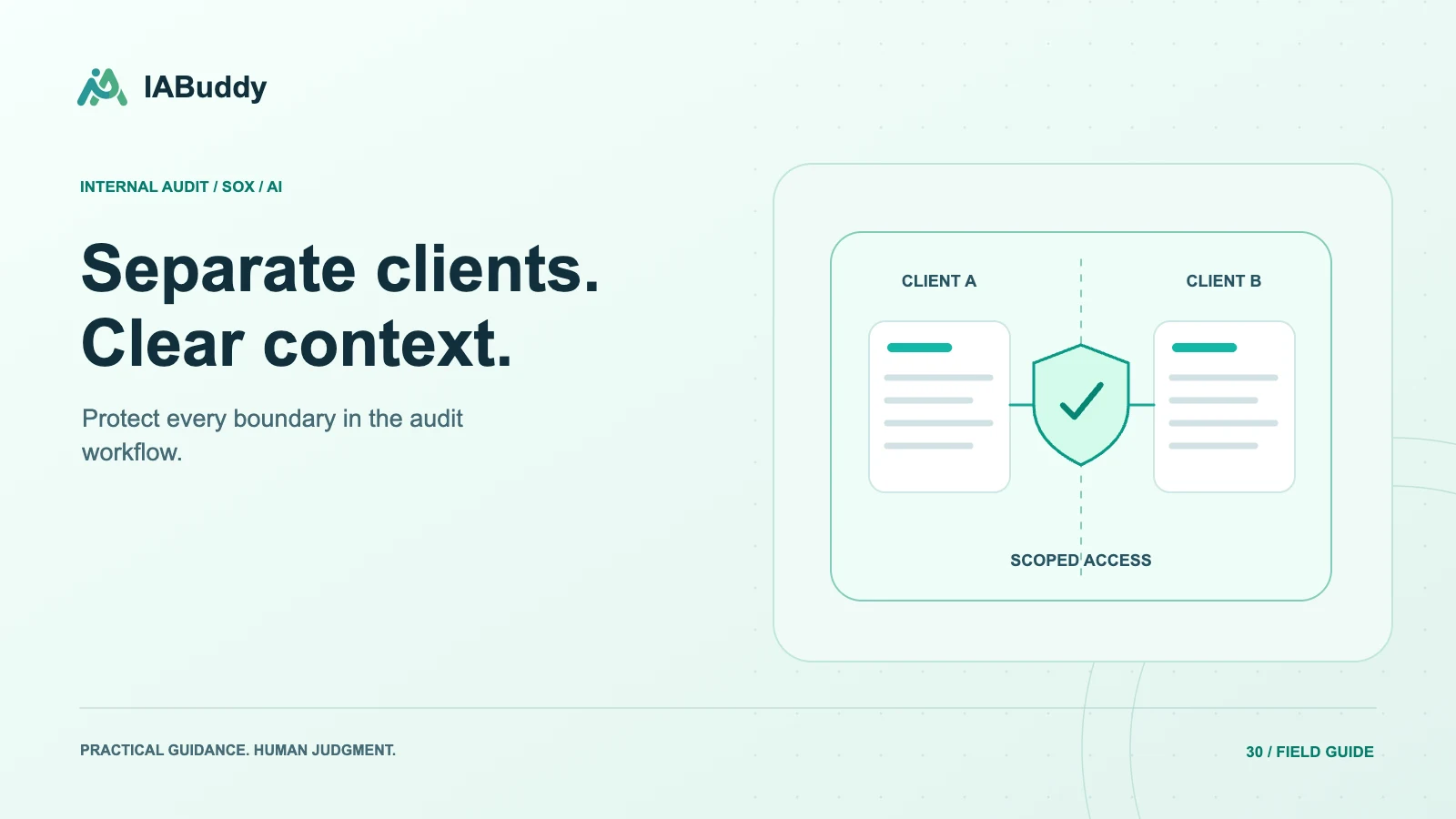
- Audit consultants managing multiple clients need clear client boundaries across storage, permissions, search, AI retrieval, notifications, and exports.
- Use distinct workspaces, least-privilege access, explicit sharing checks, and controlled offboarding.
- A multi-tenant architecture can support separation, but it does not make cross-client disclosure mathematically impossible or remove the need for testing and disciplined operation.
Define what must remain separate
Start with client identity, users, evidence, findings, reports, and contractual restrictions. A consultant may have access to several clients, while each client should see only its authorized records. The interface should make the active client obvious before an upload, request, or export.
Shared templates require care too. Reusing a control template is different from copying a prior client's confidential evidence, findings, or examples into a new workspace. Sanitize reusable material and approve what can be shared.
Test the boundary across the complete application
| Surface | Test to perform with authorization |
|---|---|
| File storage and preview | A restricted user cannot open another client's artifact |
| Search | Results do not expose unauthorized titles or snippets |
| AI retrieval | Answers do not incorporate another client's evidence |
| Notifications | Recipients and content match the correct client |
| Shared links | Scope, expiry, and revocation behave as intended |
| Exports | Only authorized records are included |
| Administration | Role changes and offboarding remove intended access |
Perform these checks in an approved test environment or with authorized test data. A visual workspace label is not proof that every retrieval path enforces the boundary.
Use least privilege and named accountability
Grant users only the access their work requires. Distinguish engagement administration, preparation, review, upload, and read-only needs according to the available role model. Review access when staff move between clients or when external reviewers finish their work.
Avoid shared credentials. Record who authorizes access, how temporary access expires, and how the firm handles local downloads. A platform permission cannot recall a file already copied into an uncontrolled location.
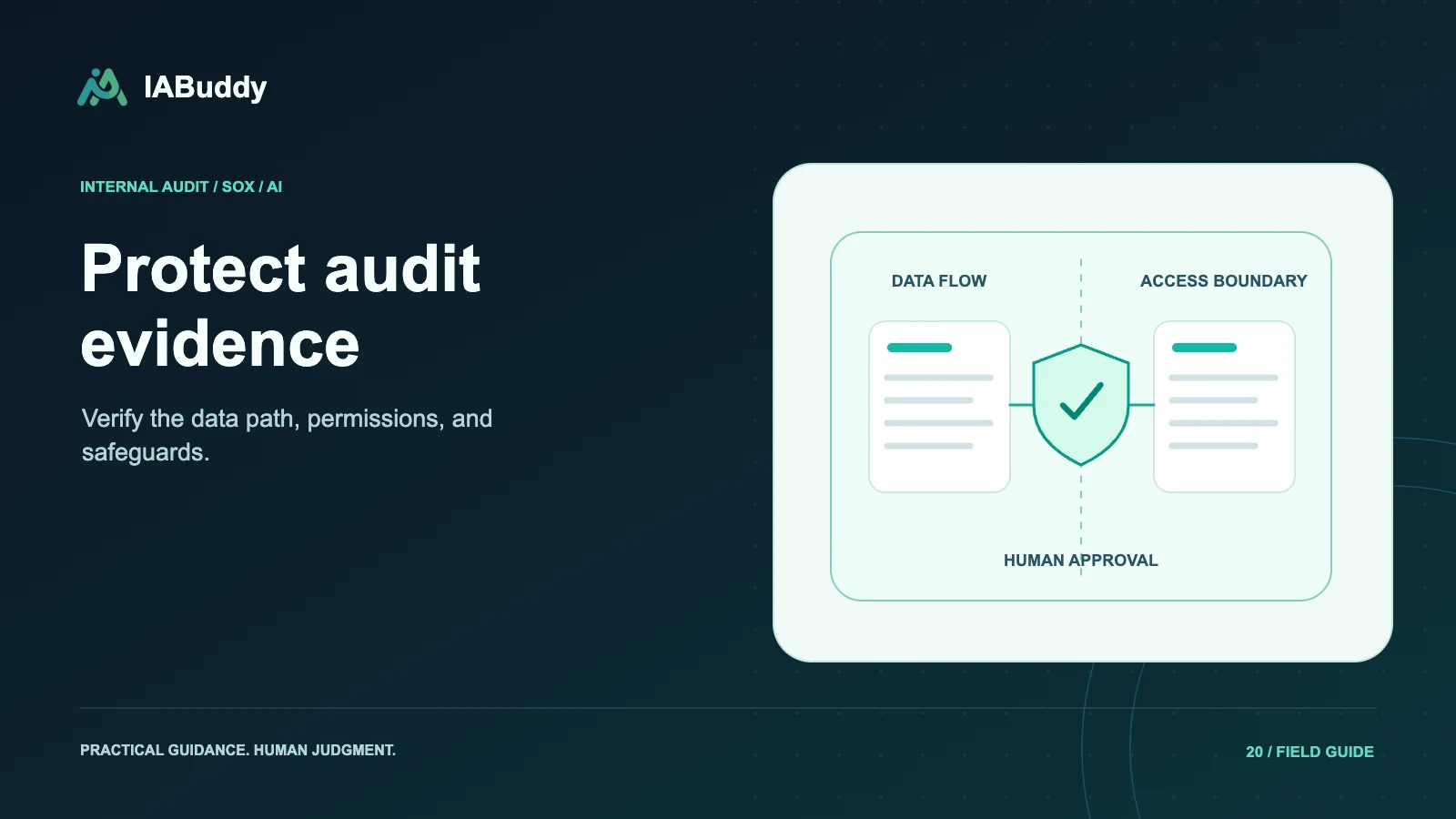
Treat AI context as a data boundary
Confirm that retrieval and generated answers respect the same client and user permissions as ordinary file access. Ask whether logs, caches, reusable prompts, or feedback could contain client data and how those records are governed.
OWASP's sensitive information disclosure guidance describes relevant application risks. Its prompt injection guidance also matters when client documents can influence the AI system's behavior.
An illustrative handoff control
Before sending an evidence request or report, display the active client, intended recipients, and included records. Require a human check when an action shares sensitive information outside the engagement team. Keep the decision and relevant activity record.
For example, a consultant preparing similar quarterly access reviews for two clients should not rely only on identical filenames to distinguish them. Stable client and engagement identifiers reduce ambiguity, but the final sharing step still needs appropriate controls.
Plan offboarding and record retention
Define what the client receives at the end of the engagement, how access is removed, and how the firm retains or deletes its copies. Consider the contract, professional obligations, legal holds, backups, and local exports. Do not assume deleting a workspace resolves every retained copy.
Test that the exported record remains understandable without ongoing access to the application. Include evidence relationships and review context as required, not just a list of completed tasks.
Evaluate IABuddy against your consulting model
Use an IABuddy demo to confirm workspace separation, roles, evidence sharing, AI retrieval scope, and export behavior for the proposed arrangement. Do not assume that a portfolio dashboard, white labeling, a particular authentication method, or every framework template is included.
Evaluate administrative effort and reviewed work quality before predicting additional client capacity. No unverified revenue multiplier or zero-risk claim should substitute for an actual pilot and security review.
Frequently asked questions
Does multi-tenancy mean client data is automatically isolated in every feature?
No assumption should be made. Verify authorization in storage, search, AI retrieval, previews, notifications, links, and exports, and test the actual deployment with appropriate authorization.
Can we reuse workpapers from one client for another?
Reuse only material that is authorized and appropriately sanitized. Client evidence, findings, personal information, and confidential context should not be copied into another engagement merely to save setup time.