Key Takeaways
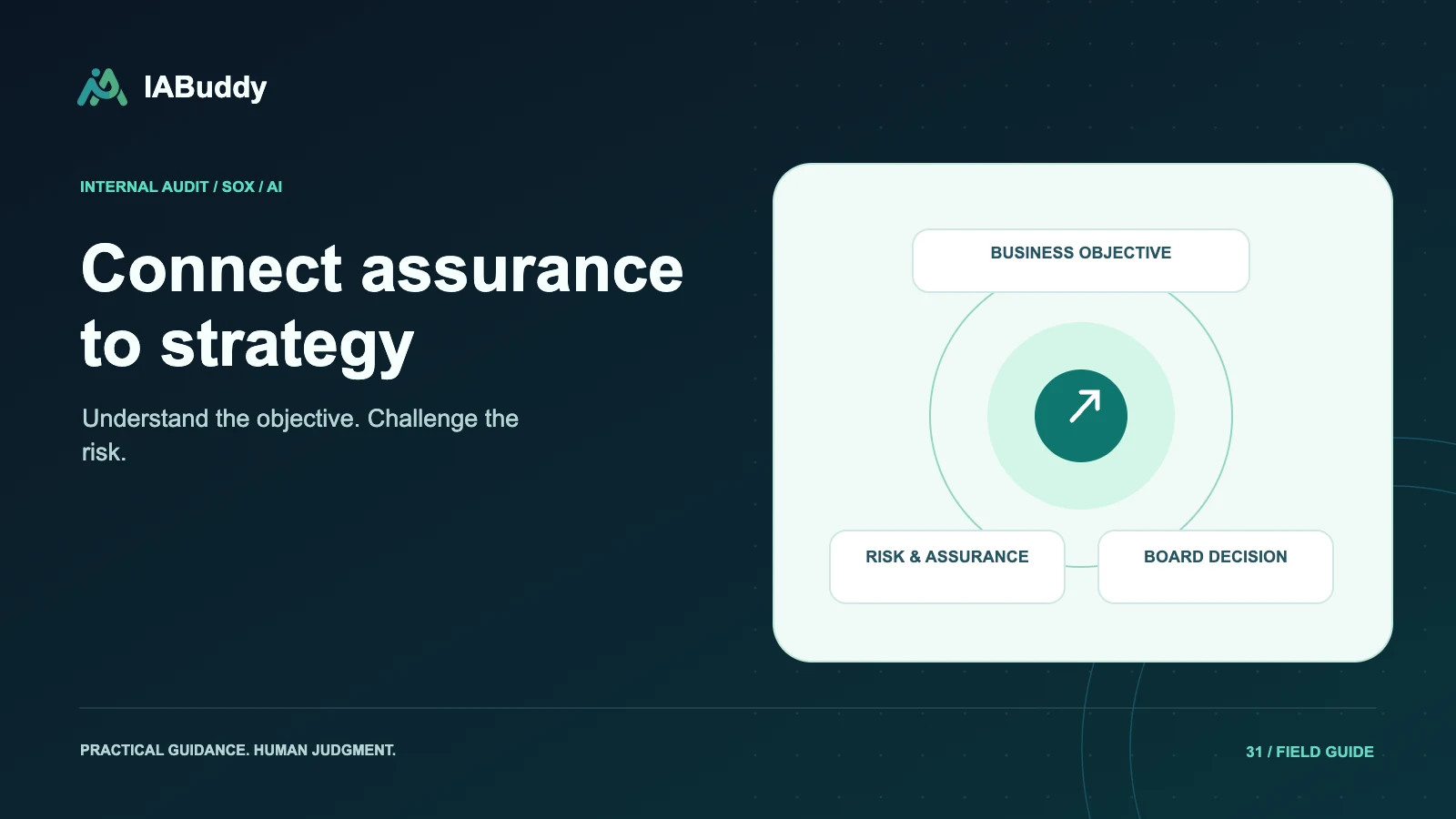
- Align internal audit with strategy by connecting business objectives to relevant risks, assessing assurance needs, and building a responsive audit plan.
- Preserve independence and objectivity: management owns decisions, controls, and remediation, while internal audit provides assurance and appropriate advice.
- Report what the findings mean for objectives without claiming that audit owns the business outcome.
Start with the organization's objectives
Understand the strategy, operating model, major initiatives, and constraints through discussions with the board and management. Translate objectives into the risks that could affect their achievement. Do not limit the conversation to the controls already listed in the prior-year audit plan.
For example, a system migration may affect business continuity, access, data conversion, and financial reporting. The audit question is which assurance work is most useful at the relevant stage, not simply whether the project appears on a strategic slide.
Connect objectives, risks, and assurance needs
| Planning layer | Question to answer |
|---|---|
| Objective | What is the organization trying to achieve? |
| Risk | What could materially interfere with that objective? |
| Existing assurance | What reliable work is already available? |
| Gap | What remains uncertain or insufficiently covered? |
| Audit response | Which engagement, timing, and expertise are appropriate? |
This is a proposed planning structure. It should complement the audit function's mandate, risk assessment, required work, and resource constraints.
Preserve the boundary with management
Collaboration does not require internal audit to design, operate, or approve management's controls. Clarify the nature of advisory work, who makes decisions, and how potential impairments to objectivity or independence are addressed. Avoid simply declaring that any advisory role is harmless.
The IIA's Global Internal Audit Standards provide the professional framework. The IIA also describes the importance of an internal audit strategic plan. Apply the relevant standards and safeguards to the actual engagement, not a generic slogan about being a business partner.
Make the plan responsive without making it arbitrary
Revisit the plan when significant risks or organizational priorities change. Record the reason for additions, deferrals, or scope changes and obtain the appropriate approvals. Explain resource limitations and the assurance implications of work that will not be performed.
A responsive plan is not a promise to predict every emerging risk. Combine stakeholder input, business changes, prior findings, and available evidence, and be explicit about uncertainty.
Translate findings into decision-useful reporting
Connect the observed condition to the relevant objective and risk, explain the evidence and limitation, and distinguish potential impact from an event that has actually occurred. Identify management's response, owner, timing, and any unresolved disagreement.
For an illustrative system migration, a finding about incomplete access review evidence could affect confidence in the transition controls. That does not prove a breach will occur or justify inventing an avoided-loss figure. The report should support an informed decision without overstating causality.
Use a balanced performance view
Track coverage of important risks, timeliness of reporting, quality review results, recurring issues, and stakeholder usefulness. Completion counts and budget measures still provide operating information, but they should not be the only view of value.
The IIA's quality assurance and improvement program guidance connects quality with conformance and performance objectives. Do not reward fewer findings, faster closure, or higher satisfaction in ways that discourage difficult but necessary conclusions.
Where IABuddy can support the operating work
IABuddy connects planning records, controls, evidence, testing, review, and follow-up. This can help preserve the context needed for reporting and reduce repeated handling. It does not automatically determine enterprise strategy, predict business outcomes, or replace the CAE's judgment.
Evaluate the internal audit workflow against a real engagement. Measure whether better-connected work improves the team's ability to explain its conclusions and direct attention to the risks that matter, while keeping management accountable for decisions and action.
Frequently asked questions
Does strategic alignment mean auditing only growth initiatives?
No. The plan should consider the mandate, important risks, required work, governance needs, and available resources. Some necessary assurance work may not directly support a named growth initiative.
Can internal audit advise management and remain independent?
Appropriate advisory work can be compatible with the mandate, but responsibilities and potential impairments must be evaluated. Management should retain ownership of decisions and controls, with safeguards applied under the relevant standards.