Key Takeaways
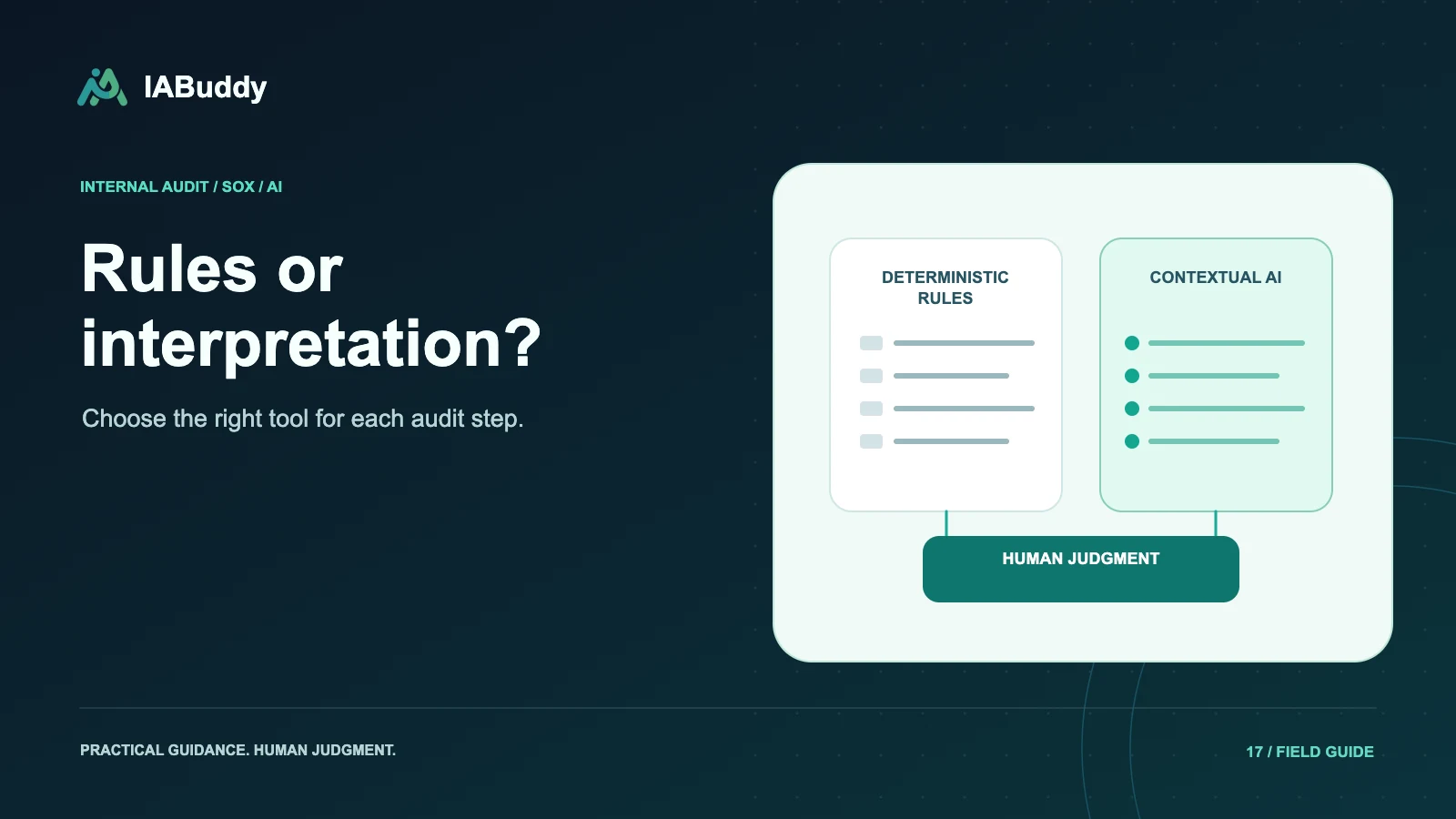
- RPA and rules-based automation execute predefined steps, while AI can help interpret variable text or propose judgments from less standardized inputs.
- They can complement one another.
- Use deterministic methods for repeatable logic and calculations, AI where interpretation adds value, and human review where evidence is ambiguous or a conclusion requires professional judgment.
What problem are you trying to automate?
Start with the task rather than a technology preference. Moving structured records between approved systems, comparing identifiers, calculating elapsed time, and interpreting a narrative are different operations. One workflow may benefit from several methods.
Do not assume that every RPA implementation uses fragile screen coordinates or that every AI system handles format changes correctly. Both require design, testing, monitoring, and maintenance. The relevant question is how the proposed solution behaves on your inputs and failure cases.
A practical comparison
| Dimension | Rules-based automation or RPA | AI-assisted interpretation |
|---|---|---|
| Task definition | Explicit steps and conditions | Interpretation from provided context |
| Suitable inputs | Stable structured records and repeatable interfaces | Variable documents and language |
| Calculations | Reproducible programmed logic | Use validated calculation tools where needed |
| Changes | Update and retest affected rules or integrations | Re-evaluate behavior on changed inputs |
| Exceptions | Defined branches or escalation | Proposed interpretation requiring validation |
| Review | Validate logic, access, and execution | Also challenge evidence-grounding and ambiguity |
This is a workflow-design comparison, not a claim that one category always outperforms the other. Product capabilities vary.
Where deterministic automation is useful
A clearly defined date comparison or reconciliation formula should be explicit and reproducible. Once the correct inputs are established, a programmed calculation can provide a stable result and an understandable rule.
The hard part may be selecting the correct inputs: which date represents approval, which account belongs to the person, or which amount is relevant. Keep extraction and interpretation separate from the calculation so a reviewer can identify where an error occurred.
Where AI may add value
AI can help locate relevant language across varying document layouts, suggest a classification, or draft an explanation. It may recognize that different labels have similar meanings, but that similarity must be evaluated in context. An invoice number and a transaction identifier are not always interchangeable.
Require references to the underlying support and define when the system should stop for review. Do not use apparent linguistic confidence as evidence that the interpretation is correct.
An illustrative combined workflow
For an approval-timing test, a document-processing step locates the approval and release events. A reviewer or validated extraction process confirms the field mapping. Deterministic logic compares the timestamps under the approved policy. AI drafts a description of the observed result, and the auditor reviews the evidence and conclusion.
If the approval date is unclear or two records conflict, the workflow routes the case for investigation. It does not simply use the most convenient value to complete the calculation. This example is a proposed design, not a product performance benchmark.
How should you evaluate resilience?
Test changed layouts, renamed fields, missing values, duplicated records, and inconsistent date formats. Include an incorrect but plausible input. Record whether the system detects the issue, stops safely, or produces a misleading result.
The NIST AI RMF Playbook is a useful voluntary resource for evaluating AI-related risks. Combine that work with validation of the ordinary software, access, and data-handling components.
Where IABuddy fits
IABuddy focuses on the connected audit workflow, including evidence-grounded first-pass testing and human-reviewed workpapers. Evaluate the AI audit automation workflow against your actual tasks rather than assuming an AI label means zero maintenance or automatic exception resolution. The goal is an understandable, reviewable process with the right method at each step.
Frequently asked questions
Does RPA always fail when a document layout changes?
No. Behavior depends on the implementation and the techniques used. Test the actual product rather than assuming all rules-based automation relies on fixed screen coordinates.
Does AI remove the need for deterministic calculations?
No. Explicit calculations and rules remain useful for repeatable audit procedures. AI-assisted extraction or drafting should not obscure the inputs, formula, and validation behind a numerical result.