Key Takeaways
- A key SOX control is a control selected as important to addressing the assessed risk of material misstatement for a relevant assertion.
- Selection depends on how controls work individually or together, including their precision and dependencies.
- A label, automation feature, or account balance alone does not determine whether a control should be tested.
Start with the reporting risk
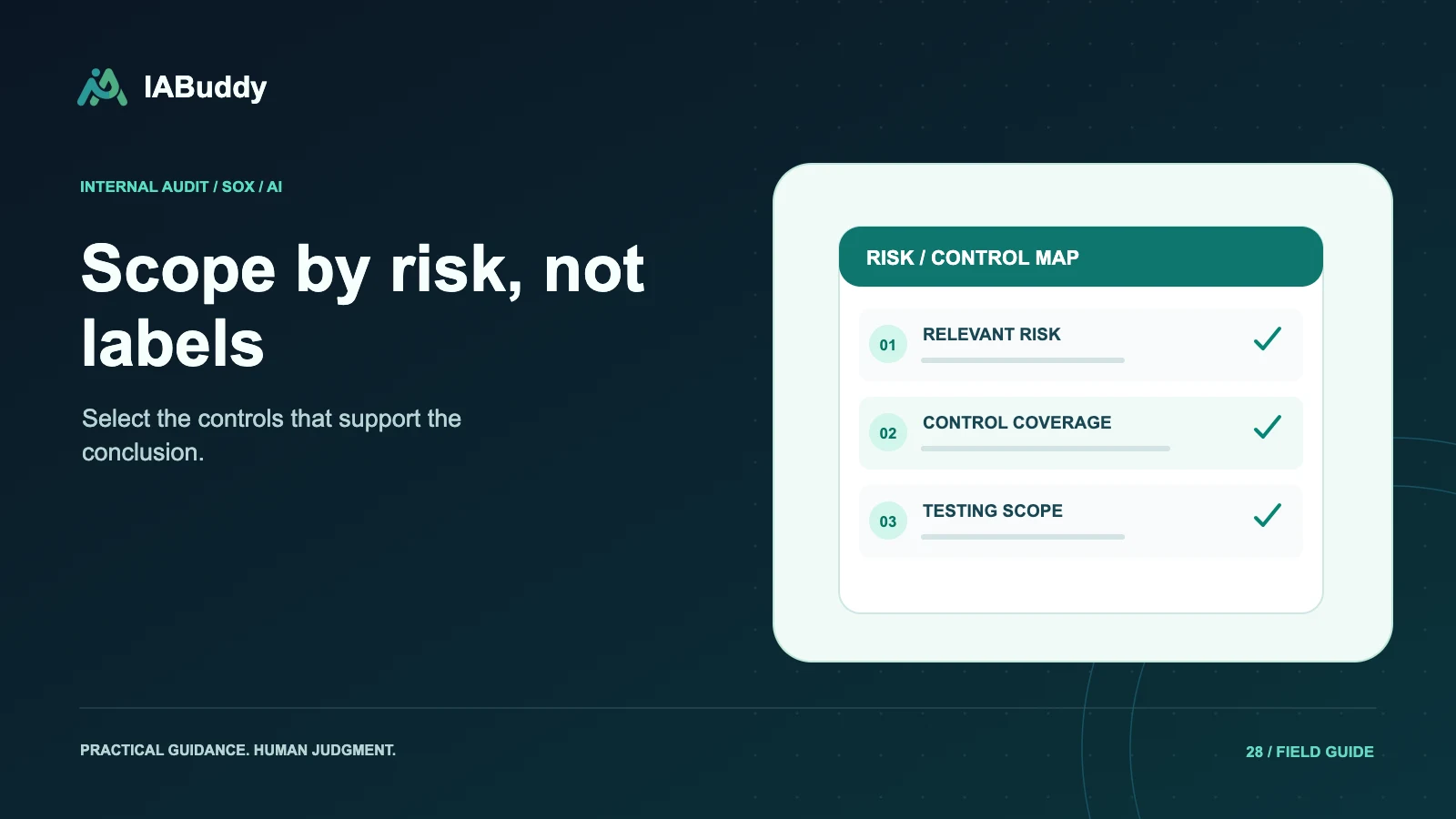
Identify what could go wrong in a significant account or disclosure and which assertions are relevant. Consider qualitative factors and how errors could arise, not only a point-in-time account balance. Then identify controls that address the assessed risks.
PCAOB AS 2201, paragraphs .39-.41 explains that selection depends on sufficient risk coverage by controls individually or in combination, rather than their labels. 'Key control' is useful program terminology, but the supporting rationale matters more than the tag.
Ask five questions about a candidate control
| Question | Why it matters |
|---|---|
| Which risk and assertion does it address? | Establishes the purpose of selection |
| How precisely does it operate? | Tests whether it can identify relevant problems |
| What information does it depend on? | Identifies report and data dependencies |
| Which people and systems make it work? | Identifies competence, access, and technology dependencies |
| What other controls contribute to coverage? | Avoids evaluating the control in isolation |
Document the answers rather than letting the system assign a key flag without explanation.
Do not confuse automated with key
An automated control may be important, but automation does not determine relevance or effectiveness. Its configuration, access, change process, and input information may affect the conclusion. A manual review may also be important when it addresses a relevant risk with sufficient precision.
For example, a system approval rule and a management review can address different aspects of a process. Removing one because the other is automated could leave a gap. This is an illustrative scoping consideration, not a universal requirement to retain both.
Evaluate entity-level controls by what they accomplish
A high-level review may support the broader control environment without being precise enough to address a particular assertion on its own. Conversely, a sufficiently precise review may be relevant to selected risks. The title or seniority of the reviewer does not settle the question.
Describe what the reviewer investigates, the level of aggregation, criteria used, and evidence of resolution. Do not assume that a board-level dashboard replaces every process-level control beneath it.
Rationalize duplicates without losing coverage
Two controls can look redundant while covering different entities, periods, systems, or failure modes. Map those differences before proposing consolidation. Some redundancy may itself serve a control objective.
Retain the documented rationale for a control removed from the testing scope and identify which remaining controls provide coverage. Discuss external-audit implications early, but do not assume the external auditor must accept the proposed reduction.
A practical scoping record
For each selected control, retain the risk linkage, relevant assertion, description, owner, frequency, dependencies, selection rationale, and planned testing approach. Record who approved the scope and when it should be reconsidered.
Review scope after changes in systems, processes, business activities, or known deficiencies. A prior-year key flag should not become a permanent decision disconnected from current risk.
How IABuddy helps organize the decision
IABuddy supports RCM records, risk and control drafting, planning, and the downstream testing workflow. Use it to preserve the rationale and relationships that support the scoping decision. AI suggestions remain drafts for qualified review, not automatic authority to retire controls.
Explore the control-testing workflow with a proposed scope change and verify that the affected tests and evidence remain understandable. The objective is defensible coverage, not simply a smaller control count.
Frequently asked questions
Should every low-balance account be excluded from SOX scope?
No automatic rule should be used. Consider relevant qualitative factors, potential misstatement, disclosures, process risks, and the approved methodology as well as quantitative measures.
Can a single control cover more than one risk or assertion?
Yes, depending on its design and operation. Document the specific coverage and dependencies rather than assuming that one broad description addresses every related risk.